
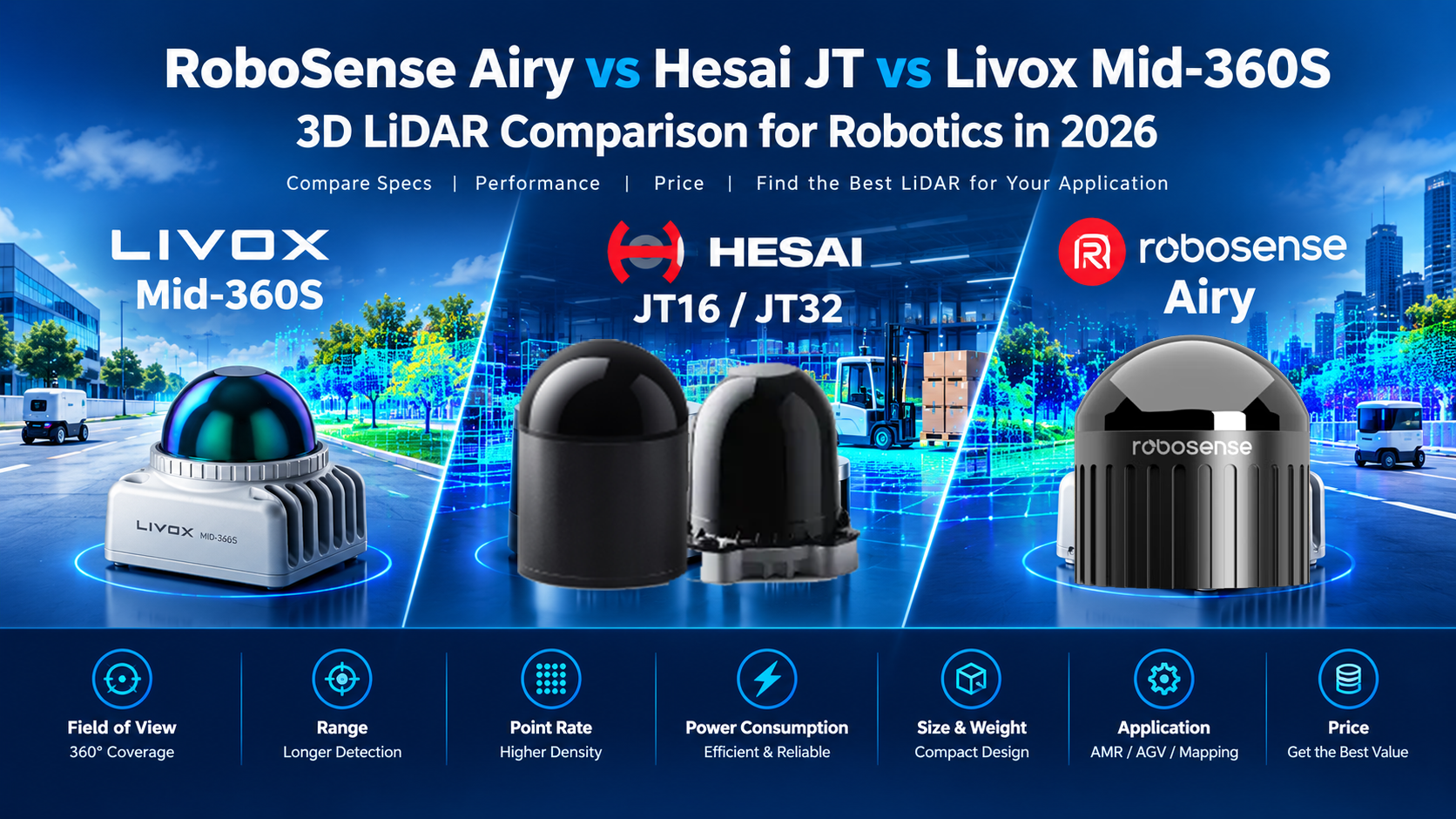
Choosing the right 3D LiDAR sensor has become an important decision for robotics companies, AMR manufacturers, AGV developers, autonomous navigation engineers, and industrial automation integrators.
Among the many compact 3D LiDAR sensors available today, three product families attract particular attention from robotics developers:
All three products are designed for applications such as robot navigation, obstacle avoidance, 3D perception, mapping, and autonomous mobile robots. However, their sensing architectures, field of view, point-cloud density, range, power consumption, physical dimensions, and pricing are different.
Therefore, simply asking which LiDAR is “better” is not the most useful way to approach the purchasing decision.
A more practical question is:
Which LiDAR provides the right combination of FOV, range, point-cloud density, size, power consumption, software integration, and price for your robot?
This article compares RoboSense Airy, Hesai JT16/JT32, and Livox Mid-360S from an engineering and purchasing perspective, helping buyers understand the differences before purchasing a robot LiDAR, 3D LiDAR sensor, AGV LiDAR, AMR LiDAR, or navigation LiDAR.
1. RoboSense Airy vs Hesai JT vs Livox Mid-360S at a Glance
Before looking at individual specifications, it is useful to understand the positioning of these three LiDAR families.
| Feature | RoboSense Airy | Hesai JT16 | Hesai JT32 | Livox Mid-360S |
|---|---|---|---|---|
| Main Application | Robotics / Mapping | Robotics / AGV | Robotics / AGV | Mobile Robotics |
| Horizontal FOV | 360° | 360° | 360° | 360° |
| Vertical FOV | 90° | 40° | 42.6° | 59° |
| Lines / Density | 96 / 192 beams | 16 | 32 | Hybrid solid-state |
| Point Rate | Up to 1.72M pts/s | 96K pts/s | 192K pts/s | 200K pts/s |
| Range | Up to 50 m @10%* | 30 m max | 65 m max | 40 m @10% reflectivity |
| Minimum Detection | — | — | — | 0.1 m |
| Power | <8 W | 4.3 W | 4.3 W | 6.5 W |
| Size | φ60 × H63 mm* | φ62 × H64 mm | φ62 × H64 mm | 65 × 65 × 60 mm |
| Weight | Compact | <200 g / 200 g | <200 g | 265 g |
| IMU | Integrated | — | — | Integrated |
| Architecture | Digital / rotary array | Compact rotary | Compact rotary | Hybrid solid-state |
| Typical Use | Mapping / Navigation | Small AGV / Robot | AGV / Robot | AMR / Mapping |
*Specifications may vary by product version and test conditions; always confirm the final manufacturer’s datasheet before production deployment.
RoboSense’s official Airy specifications list 360° horizontal and 90° vertical FOV, 192/96 beams, 1.72 million points per second, 30 m @10% reflectivity, 1 cm @1σ precision, integrated IMU, approximately 60 × 63 mm dimensions and less than 8 W power consumption.
Hesai’s official JT series specifications show that JT16 provides 360° × 40° FOV, 30 m ranging capability and 96,000 pts/s, while JT32 provides 360° × 42.6° FOV, 65 m maximum range and 192,000 pts/s. Both are compact 3D LiDAR products designed for robotics and industrial applications.
Livox Mid-360S provides 360° horizontal FOV, approximately -7° to 52° vertical FOV, 40 m @10% reflectivity typical range, 200,000 points/s, 0.1 m close-proximity blind zone, 6.5 W typical power consumption, IP67 protection and a 65 × 65 × 60 mm body weighing 265 g.
2. RoboSense Airy: High-Density 3D Perception for Robots
RoboSense Airy is positioned as a compact hemispherical digital LiDAR for robotics.
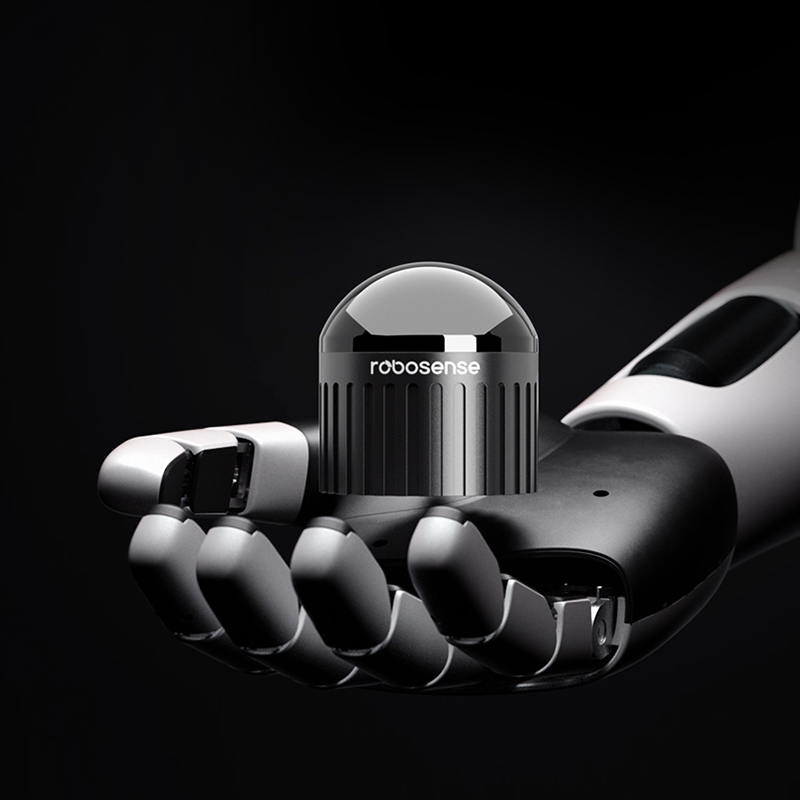
Its most obvious characteristic is its extremely wide vertical field of view.
Airy provides:
360° horizontal FOV × 90° vertical FOV
This is significantly wider vertically than many conventional compact 3D LiDAR sensors.
According to RoboSense, Airy supports 96- or 192-beam configurations and can generate up to 1.72 million points per second. It also provides 1 cm @1σ range precision and integrates an IMU.
This makes the Airy particularly interesting for robots that need to perceive not only the area directly ahead but also objects at different heights and angles.
Potential applications include:
- AMR navigation
- AGV navigation
- Robot dogs
- Service robots
- Inspection robots
- Warehouse robots
- Outdoor mobile robots
- 3D mapping
- SLAM
- Obstacle avoidance
- Intelligent logistics
Why is the 90° vertical FOV important?
Imagine a mobile robot moving through a warehouse.
A conventional sensor with a relatively narrow vertical field of view may focus mainly on the horizontal environment.
However, the robot may encounter:
- Low obstacles
- Pallets
- Boxes
- Shelves
- Human legs
- Raised objects
- Sloping terrain
- Overhanging structures
A larger vertical FOV can increase the amount of the surrounding environment captured by one sensor.
This can reduce blind areas and provide more information for perception algorithms.
3. Hesai JT16 and JT32: Compact LiDAR for Cost-Sensitive Robotics
The Hesai JT family takes a somewhat different approach.

Instead of maximizing point-cloud density, JT16 and JT32 focus heavily on compact size, 360° horizontal coverage, low power consumption, and robot integration.
The official Hesai JT series page describes the family as mini 3D LiDAR products designed for robotics and industrial applications. JT16 provides 16 channels and 30 m ranging capability, while JT32 increases the channel count to 32 and the maximum ranging capability to 65 m.
Hesai JT16
JT16 provides:
- 16 channels
- 360° horizontal FOV
- 40° vertical FOV
- 30 m maximum ranging capability
- 96K pts/s
- 4.3 W power consumption
- Approximately 64 mm × 62 mm dimensions
- Approximately 200 g weight
Hesai JT32
JT32 provides:
- 32 channels
- 360° horizontal FOV
- 42.6° vertical FOV
- 65 m maximum ranging capability
- 192K pts/s
- 4.3 W power consumption
- Approximately 64 mm × 62 mm dimensions
- Less than 200 g weight
For developers building cost-sensitive robots, the JT series can be attractive because a 16- or 32-channel sensor may provide enough environmental information without requiring a much higher-performance LiDAR.
LidarSeek currently lists JT16 at approximately $450 and JT32 at approximately $620, although online prices should be treated as indicative and project-specific quotation should be requested for volume purchasing.
4. Livox Mid-360S: Compact 360° LiDAR for Mobile Robots
The Livox Mid-360S is designed specifically for intelligent mobile robots.

Livox describes it as a new-generation 3D LiDAR using hybrid solid-state technology, with compact dimensions and low weight for mobile robotic platforms.
Its core specifications include:
- 360° horizontal FOV
- Approximately 59° vertical FOV
- 40 m @10% reflectivity typical detection range
- 100 m cut-off range
- 0.1 m close-proximity blind zone
- 200K points/s
- 10 Hz typical frame rate
- 6.5 W typical power
- 265 g weight
- 65 × 65 × 60 mm dimensions
- IP67 protection
- Built-in IMU
- Ethernet interface
- PTPv2 / GPS synchronization
These specifications make Mid-360S particularly interesting for mobile robots that need full 360° environmental perception but have strict limitations on size, weight, power, and BOM cost.
LidarSeek currently lists the Mid-360S at approximately $749, although actual pricing may change according to supply, quantity, and project requirements.
5. Field of View Comparison
Field of view is one of the most important parameters when selecting a 3D LiDAR sensor for robotics.
All three product families provide 360° horizontal coverage, but their vertical coverage is significantly different.
| Product | Horizontal FOV | Vertical FOV |
|---|---|---|
| RoboSense Airy | 360° | 90° |
| Hesai JT16 | 360° | 40° |
| Hesai JT32 | 360° | 42.6° |
| Livox Mid-360S | 360° | 59° |
This creates three different sensing profiles.
Airy
Airy has the widest vertical FOV of the three.
This can be useful when the robot needs broad vertical environmental perception.
JT16 / JT32
The JT series has a narrower vertical FOV but remains highly compact and power-efficient.
This can be suitable for conventional mobile robot navigation.
Mid-360S
Mid-360S sits between these approaches with approximately 59° vertical coverage.
For many AMRs and mobile robots, this provides a useful balance between vertical perception and compactness.
6. Point Cloud Density Comparison
Point rate affects how much 3D information a LiDAR can produce.
The approximate comparison is:
| Product | Point Rate |
|---|---|
| RoboSense Airy | Up to 1.72M pts/s |
| Hesai JT16 | 96K pts/s |
| Hesai JT32 | 192K pts/s |
| Livox Mid-360S | 200K pts/s |
The difference is significant.
Airy’s maximum point rate is considerably higher than JT16, JT32, and Mid-360S.
This can be valuable for applications requiring dense 3D point clouds.
However, higher point rate also means more data.
That may increase requirements for:
- Ethernet bandwidth
- CPU/GPU processing
- Point-cloud storage
- SLAM processing
- Object detection algorithms
- Robot computer performance
Therefore:
Higher point rate does not automatically mean lower system cost.
If a robot only requires basic navigation and obstacle avoidance, a 200K pts/s LiDAR may already be sufficient.
If the robot performs high-resolution 3D mapping, object perception, or complex sensor fusion, a high-density sensor such as Airy may provide more useful information.
7. Range Comparison
Range is another major purchasing parameter.
| Product | Published Range |
|---|---|
| RoboSense Airy | 30 m @10% reflectivity / up to 50 m in LidarSeek listing |
| Hesai JT16 | 30 m max |
| Hesai JT32 | 65 m max |
| Livox Mid-360S | 40 m @10% reflectivity typical |
| Livox Mid-360S | 100 m cut-off range |
The test conditions behind these numbers are important.
A LiDAR’s maximum range is affected by:
- Target reflectivity
- Ambient light
- Atmospheric conditions
- Target size
- Incident angle
- Detection algorithms
- Sensor configuration
Therefore, buyers should not compare only the largest number shown in a product description.
For warehouse robots operating at 10–20 meters, 30–40 meters may already be sufficient.
For outdoor robots or large industrial facilities, the additional range of JT32 or other higher-performance models may become more important.
8. Accuracy Comparison
Accuracy is particularly important for mapping and localization.
RoboSense Airy specifies approximately 1 cm @1σ range precision.
Livox Mid-360S specifies:
- ≤2 cm @10 m under its stated test condition
- ≤4 cm @0.2 m under its stated test condition
The exact test conditions are important when comparing precision values between manufacturers.
Hesai JT16 provides a stated range precision of ±3 cm, while JT32 lists 0.5 cm accuracy under its specified 1–5 m test condition.
For a purchasing team, the correct method is therefore not simply:
“Which number is smallest?”
Instead, compare:
accuracy + range + target reflectivity + temperature + distance + scanning mode
under equivalent test conditions.
9. Size and Weight Comparison
Compact size is especially important for:
- Robot dogs
- Humanoid robots
- Service robots
- Delivery robots
- Small AMRs
- UAVs
- Indoor robots
Approximate dimensions include:
| Product | Dimensions | Weight |
|---|---|---|
| RoboSense Airy | φ60 × H63 mm | Compact |
| Hesai JT16 | H64 × φ62 mm | ~200 g |
| Hesai JT32 | H64 × φ62 mm | <200 g |
| Livox Mid-360S | 65 × 65 × 60 mm | 265 g |
All three are compact enough for many mobile robot designs.
However, system designers should also consider:
- Cable routing
- Mounting bracket
- Connector position
- Heat dissipation
- Sensor height
- Protection housing
- Vibration isolation
The physical LiDAR dimensions are only part of the final installation footprint.
10. Power Consumption Comparison
For battery-powered robots, power consumption can directly affect operating time.
| Product | Approximate Power |
|---|---|
| RoboSense Airy | <8 W |
| Hesai JT16 | 4.3 W |
| Hesai JT32 | 4.3 W |
| Livox Mid-360S | 6.5 W |
Hesai JT therefore has an advantage in raw power consumption among these products, while Airy provides substantially higher point-cloud output.
Mid-360S sits between them.
This demonstrates an important engineering trade-off:
Data density vs power consumption
A robot manufacturer should calculate the complete power budget rather than evaluating the LiDAR alone.
For example:
LiDAR + NVIDIA Jetson + cameras + motors + wireless communication + onboard computer
can consume substantially more power than the LiDAR itself.
11. Which LiDAR Is Better for AMR?
AMR applications typically require:
- 360° perception
- Reliable obstacle detection
- SLAM
- Localization
- Navigation
- Low blind zones
- Compact installation
- Stable Ethernet communication
- Reasonable power consumption
All three products can be considered for AMR applications, but they emphasize different characteristics.
RoboSense Airy
Airy can be attractive for AMRs requiring dense point clouds and very wide vertical coverage.
Hesai JT16
JT16 can be considered when the robot needs basic 360° 3D perception while maintaining a low power and cost structure.
Hesai JT32
JT32 provides more channels and longer maximum ranging capability than JT16.
It can be useful when a small robot requires additional perception range.
Livox Mid-360S
Mid-360S provides 360° horizontal coverage, a wide vertical FOV, a 0.1 m minimum detection distance, integrated IMU and low power consumption, making it relevant to mobile robot navigation and obstacle avoidance.
12. Which LiDAR Is Better for Warehouse Robots?
Warehouse robots usually operate in relatively controlled environments.
Typical requirements include:
- 10–30 m perception
- Human detection
- Pallet detection
- Shelf detection
- SLAM
- Localization
- Obstacle avoidance
- Long operating hours
For these applications, extremely long range may not be necessary.
A company manufacturing hundreds or thousands of robots should pay close attention to sensor cost.
For example, if a robot manufacturer deploys 1,000 robots, a difference of $300 per LiDAR represents:
$300 × 1,000 = $300,000
Therefore, the cheapest sensor is not necessarily the best, but neither is the highest-performance sensor automatically the most economical.
The goal should be:
Minimum required specification + reliable performance + competitive LiDAR price
13. Which LiDAR Is Better for 3D Mapping?
Mapping requirements can be more demanding than basic navigation.
A mapping robot may need:
- Dense point clouds
- High range precision
- Wide FOV
- Stable frame rate
- Accurate synchronization
- IMU
- Reliable timestamping
- Strong SLAM compatibility
RoboSense Airy’s high point rate and 90° vertical FOV can be useful for dense 3D perception and mapping.
Mid-360S also supports PTPv2 and GPS synchronization and integrates an IMU, making it relevant to mapping and localization systems.
For mapping projects, buyers should test the actual point-cloud quality with their SLAM software rather than selecting a sensor solely according to the specification sheet.
14. ROS and Software Integration
Software support is often overlooked when purchasing a LiDAR.
A LiDAR sensor may have excellent hardware specifications, but if integration with the robot’s software stack is difficult, development costs can increase.
Typical robotics systems may use:
- ROS
- ROS 2
- SLAM
- Navigation Stack
- NVIDIA Jetson
- Ubuntu Linux
- PCL
- Open3D
- Custom C++ applications
- Python processing
Livox Mid-360S is supported through the Livox software ecosystem, and LidarSeek’s product information notes support for Windows, Linux, Mac OS and ROS through Livox SDK2.
For any sensor purchase, developers should confirm:
- ROS version
- ROS 2 compatibility
- SDK availability
- UDP packet format
- Timestamp format
- IMU output
- Coordinate system
- Calibration procedure
- Point-cloud format
- Driver maintenance
15. LiDAR Price Comparison
Price is one of the most important reasons customers compare these three products.
LidarSeek currently lists:
- Hesai JT16: approximately $450
- Hesai JT32: approximately $620
- RoboSense Airy: approximately $672
- Livox Mid-360S: approximately $749
These prices are website-listed indicative prices and can change according to product version, availability, quantity, promotions, and project quotation.
This creates an interesting market segment.
The three product families are not separated by extremely large price differences.
Instead, buyers can potentially choose between:
Lower-cost compact 3D LiDAR
Higher-density robotics LiDAR
Balanced 360° mobile robotics LiDAR
depending on the project requirements.
For bulk orders, OEM projects, robot manufacturers, universities, and system integrators, it is worth requesting a project-specific quotation rather than relying only on the displayed retail price.
16. RoboSense Airy vs Hesai JT vs Livox Mid-360S: Application Matrix
| Application | Airy | JT16 | JT32 | Mid-360S |
|---|---|---|---|---|
| Small AMR | ✓ | ✓ | ✓ | ✓ |
| Warehouse Robot | ✓ | ✓ | ✓ | ✓ |
| AGV | ✓ | ✓ | ✓ | ✓ |
| Service Robot | ✓ | ✓ | ✓ | ✓ |
| Robot Dog | ✓ | ✓ | ✓ | ✓ |
| Humanoid Robot | ✓ | ✓ | ✓ | ✓ |
| 3D Mapping | ✓✓ | ✓ | ✓ | ✓✓ |
| High-Density Mapping | ✓✓ | △ | ✓ | ✓ |
| Long Range | ✓ | △ | ✓✓ | ✓ |
| Low Power | ✓ | ✓✓ | ✓✓ | ✓ |
| Wide Vertical FOV | ✓✓ | △ | △ | ✓ |
| Low-Cost Robotics | ✓ | ✓✓ | ✓✓ | ✓ |
| Compact Integration | ✓✓ | ✓✓ | ✓✓ | ✓✓ |
The symbols above are intended as a technical comparison framework, not a universal ranking.
The correct sensor depends on the actual project.
17. How to Choose the Right LiDAR for Your Robot
Before purchasing, answer the following questions.
Question 1: How far must the robot detect obstacles?
If your robot operates indoors at 10–20 meters, you may not need a long-range LiDAR.
Question 2: How wide is the required vertical FOV?
If the robot needs to detect objects above and below its main horizontal plane, Airy or Mid-360S may deserve closer consideration.
Question 3: How much point-cloud data can your computer process?
A 1.72M pts/s sensor generates substantially more information than a 96K pts/s sensor.
Question 4: What is the robot’s power budget?
For battery-powered platforms, every watt matters.
Question 5: What is your target BOM cost?
For mass production, even a small LiDAR price difference can have a significant impact.
Question 6: What software platform are you using?
Check ROS, ROS 2, SDK, UDP, PTP, IMU, and timestamp compatibility before purchasing.
Question 7: How many sensors do you need?
A prototype with two LiDARs has different procurement economics from a production robot requiring 1,000 or 10,000 units.
18. Where to Buy RoboSense, Hesai and Livox LiDAR?
For international buyers, finding the correct sensor is only the first step.
Procurement also involves:
- Current inventory
- Product authenticity
- Delivery time
- Technical documentation
- Quantity pricing
- Shipping
- Warranty
- Integration support
- Replacement units
- Project-level quotations
LidarSeek currently provides product catalogs covering RoboSense, Hesai and Livox LiDAR, together with LiDAR comparison resources and quotation support. Its RoboSense catalog, for example, includes Airy alongside Helios, M1, M2, EMX and other models, while the Hesai catalog includes JT16, JT32, JT64P, JT128 and other robotics LiDAR products.
LidarSeek positions its offering around affordable LiDAR sensors, factory-direct pricing and competitive bulk rates, which can be particularly relevant for robot manufacturers, integrators and engineering teams purchasing multiple units.
For customers comparing several models, the most practical approach is to provide:
- Application
- Required range
- Required FOV
- Robot size
- Quantity
- Target price
- Indoor/outdoor environment
- ROS/ROS 2 requirement
The supplier can then help narrow down the appropriate LiDAR models.
19. Final Comparison: Airy vs Hesai JT vs Mid-360S
The three product families represent different approaches to compact robotics LiDAR.
RoboSense Airy focuses strongly on high-density 3D perception, with 360° × 90° hemispherical coverage, up to 1.72M points/s and 1 cm @1σ precision according to RoboSense’s published specifications.
Hesai JT16/JT32 focuses on compact 360° robotics perception, with JT16 offering 30 m maximum ranging capability and JT32 extending to 65 m, while maintaining approximately 4.3 W power consumption.
Livox Mid-360S focuses on compact mobile robotics perception with 360° horizontal coverage, approximately 59° vertical FOV, 0.1 m close-range detection, 200K points/s, 6.5 W typical power consumption, integrated IMU and IP67 protection.
Therefore, the selection can be approached as follows:
If you prioritize high-density 3D perception:
Consider RoboSense Airy.
If you prioritize compact size, low power and cost:
Consider Hesai JT16.
If you need additional range while maintaining a compact form factor:
Consider Hesai JT32.
If you need a balanced 360° mobile robotics LiDAR:
Consider Livox Mid-360S.
The most important lesson is that there is no single LiDAR specification that determines the best sensor for every robot.
The correct purchasing decision should combine:
Range + FOV + Point Rate + Accuracy + Size + Power + Software + Reliability + Price
Frequently Asked Questions — RoboSense Airy vs Hesai JT vs Livox Mid-360S
FAQ 1: Which LiDAR is better, RoboSense Airy, Hesai JT or Livox Mid-360S?
The answer depends on the application.
Airy emphasizes high-density hemispherical perception, Hesai JT emphasizes compact 360° robotics sensing, while Mid-360S provides a balance of wide FOV, compact size, low power and mobile robot integration.
FAQ 2: Which LiDAR has the widest vertical FOV?
Among these products, RoboSense Airy provides the widest published vertical FOV at 90°.
Hesai JT16 provides 40°, JT32 provides 42.6°, while Livox Mid-360S provides approximately 59° vertical coverage.
FAQ 3: Which LiDAR has the highest point rate?
RoboSense Airy has the highest published point rate among these models, with up to 1.72 million points per second.
Hesai JT16 provides 96K pts/s, JT32 provides 192K pts/s, and Mid-360S provides 200K pts/s.
FAQ 4: Which LiDAR is suitable for an AMR?
All three can be evaluated for AMR applications.
The final choice depends on required range, FOV, point-cloud density, robot computer performance, power budget, software compatibility and price.
FAQ 5: Which LiDAR is more suitable for warehouse robots?
For warehouse robots, compact sensors such as Hesai JT16/JT32 and Livox Mid-360S can be considered when the operating environment does not require extremely long range.
RoboSense Airy can be considered when higher-density point clouds and wider vertical perception are important.
FAQ 6: Is Livox Mid-360S suitable for SLAM?
Yes.
Mid-360S is designed for mobile robotics applications involving navigation and obstacle avoidance, and it supports PTPv2/GPS synchronization and includes an integrated IMU. Livox also provides its software ecosystem and SDK support for development.
However, actual SLAM performance depends on the complete system, including mounting position, IMU calibration, odometry, computing platform and SLAM algorithm.
FAQ 7: Is Hesai JT16 good for a small robot?
JT16 is specifically positioned by Hesai for robotics and industrial applications.
It provides 360° horizontal FOV, 40° vertical FOV, 30 m maximum ranging capability and 96K pts/s, making it relevant to compact AGVs and service robots.
FAQ 8: Is Hesai JT32 better than JT16?
JT32 provides more channels, a wider vertical FOV and a longer maximum ranging capability than JT16.
However, whether those additional capabilities justify the additional cost depends on the robot’s requirements.
For a simple indoor robot, JT16 may provide enough sensing performance.
For larger environments or robots requiring more vertical information, JT32 may be worth evaluating.
FAQ 9: What is the approximate price of these LiDAR sensors?
LidarSeek currently lists approximately:
- Hesai JT16 — $450
- Hesai JT32 — $620
- RoboSense Airy — $672
- Livox Mid-360S — approximately $749
These are indicative online prices and should not be considered permanent quotations. Bulk orders and project purchases may receive different pricing.
FAQ 10: Can I buy RoboSense Airy, Hesai JT and Livox Mid-360S from LidarSeek?
LidarSeek provides LiDAR products and comparison resources across multiple manufacturers, including RoboSense, Hesai and Livox product families.
For engineering or production projects, buyers can request a quotation based on model, quantity, application and delivery requirements.
FAQ 11: Which LiDAR has the lowest power consumption?
Among the specifications compared here, Hesai JT16 and JT32 list approximately 4.3 W power consumption.
Livox Mid-360S lists 6.5 W typical power consumption, while RoboSense Airy lists less than 8 W.
FAQ 12: What should I provide when requesting a LiDAR quotation?
For a more accurate quotation, provide:
- LiDAR model or preferred brands
- Application
- Required detection range
- Required FOV
- Quantity
- Indoor or outdoor environment
- ROS/ROS 2 requirement
- Target delivery location
- Expected annual quantity
- Target budget
This information allows the supplier to provide a more useful product and pricing comparison.
SEO Information
SEO Title:
RoboSense Airy vs Hesai JT vs Livox Mid-360S
Meta Description:
Compare RoboSense Airy, Hesai JT16/JT32 and Livox Mid-360S LiDAR for AMR, AGV, robotics and mapping. Compare range, FOV, point rate, power and price.
Focus Keyword:
RoboSense Airy vs Hesai JT vs Livox Mid-360S
Secondary Keywords:
- RoboSense Airy
- Hesai JT16
- Hesai JT32
- Livox Mid-360S
- Airy LiDAR
- Hesai LiDAR
- Livox LiDAR
- 3D LiDAR sensor
- robot LiDAR
- LiDAR for robotics
- LiDAR for AMR
- LiDAR for AGV
- LiDAR for SLAM
- 360 degree LiDAR
- compact LiDAR sensor
- affordable LiDAR
- LiDAR sensor price
- 3D LiDAR price
- robotics LiDAR comparison
- LiDAR comparison
- mobile robot LiDAR
- autonomous navigation LiDAR
Recommended Permalink:
/robosense-airy-vs-hesai-jt-vs-livox-mid360s.html
Recommended CTA:









