
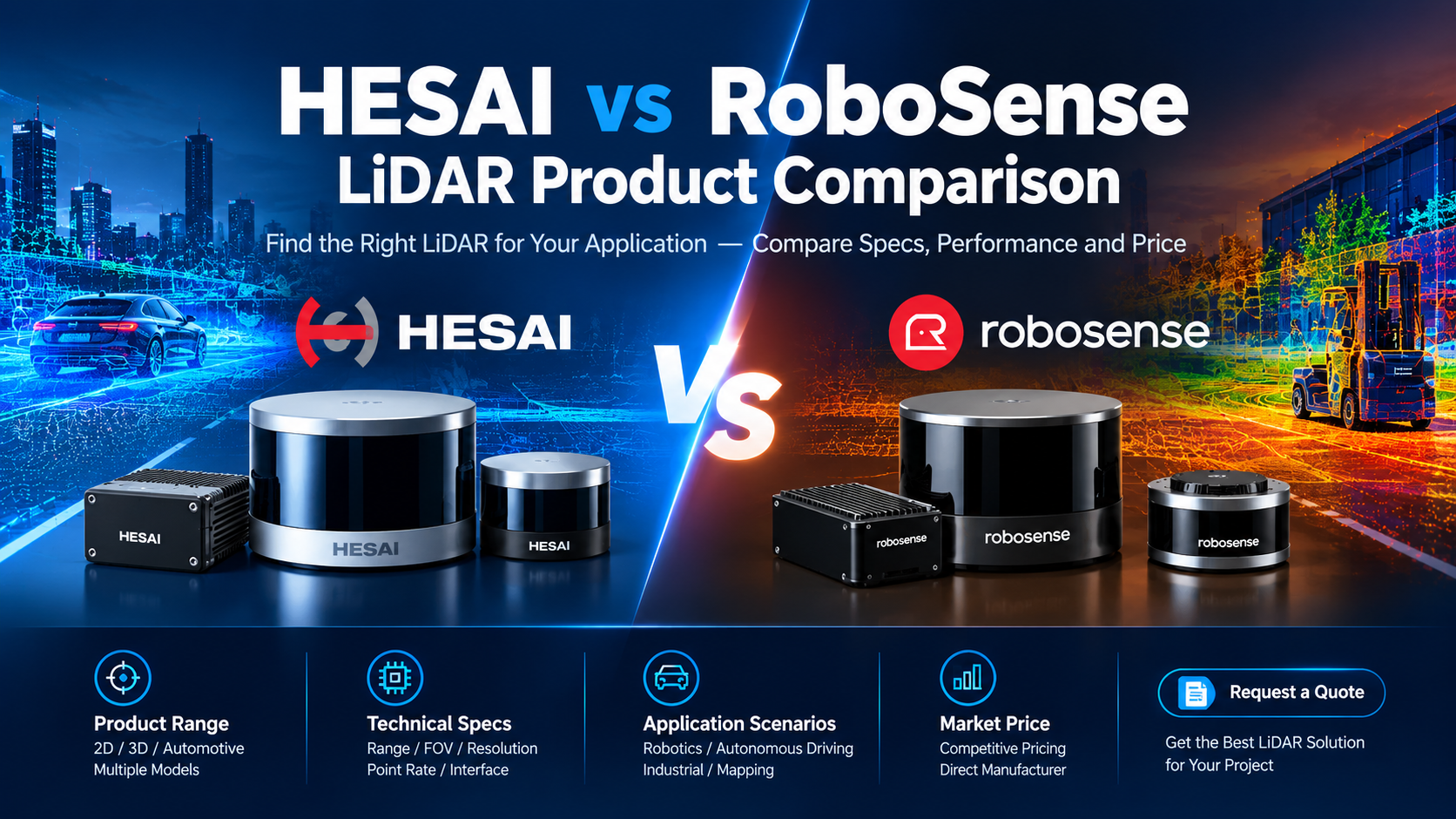
When engineers, robotics companies, autonomous driving developers, and industrial automation companies begin sourcing a LiDAR sensor, two manufacturers frequently appear on the shortlist: Hesai and RoboSense.
Both companies offer a broad range of LiDAR products covering automotive perception, autonomous driving, robotics, AGV/AMR navigation, industrial automation, mapping, and intelligent perception. However, the two product portfolios are not simply interchangeable.
The right comparison depends on the application.
A 16-channel LiDAR for an indoor AGV should not be compared with a 128-line automotive LiDAR only because both are described as “3D LiDAR.” Likewise, a compact solid-state blind-spot sensor has a completely different purpose from a 360° mechanical LiDAR used for mapping.
For buyers, the more useful question is:
Which Hesai LiDAR is most closely matched to a RoboSense LiDAR for my application, and which option provides the required performance at a reasonable total cost?
This guide provides a practical Hesai vs RoboSense LiDAR comparison based on the product categories currently available through LidarSeek. The comparison covers automotive LiDAR, 3D robotics LiDAR, industrial LiDAR, blind-spot LiDAR, specifications, applications, price considerations, integration, and procurement.
Hesai vs RoboSense: Why Compare These Two LiDAR Brands?
Hesai and RoboSense both have extensive LiDAR product portfolios, but their products are positioned across several different application categories.
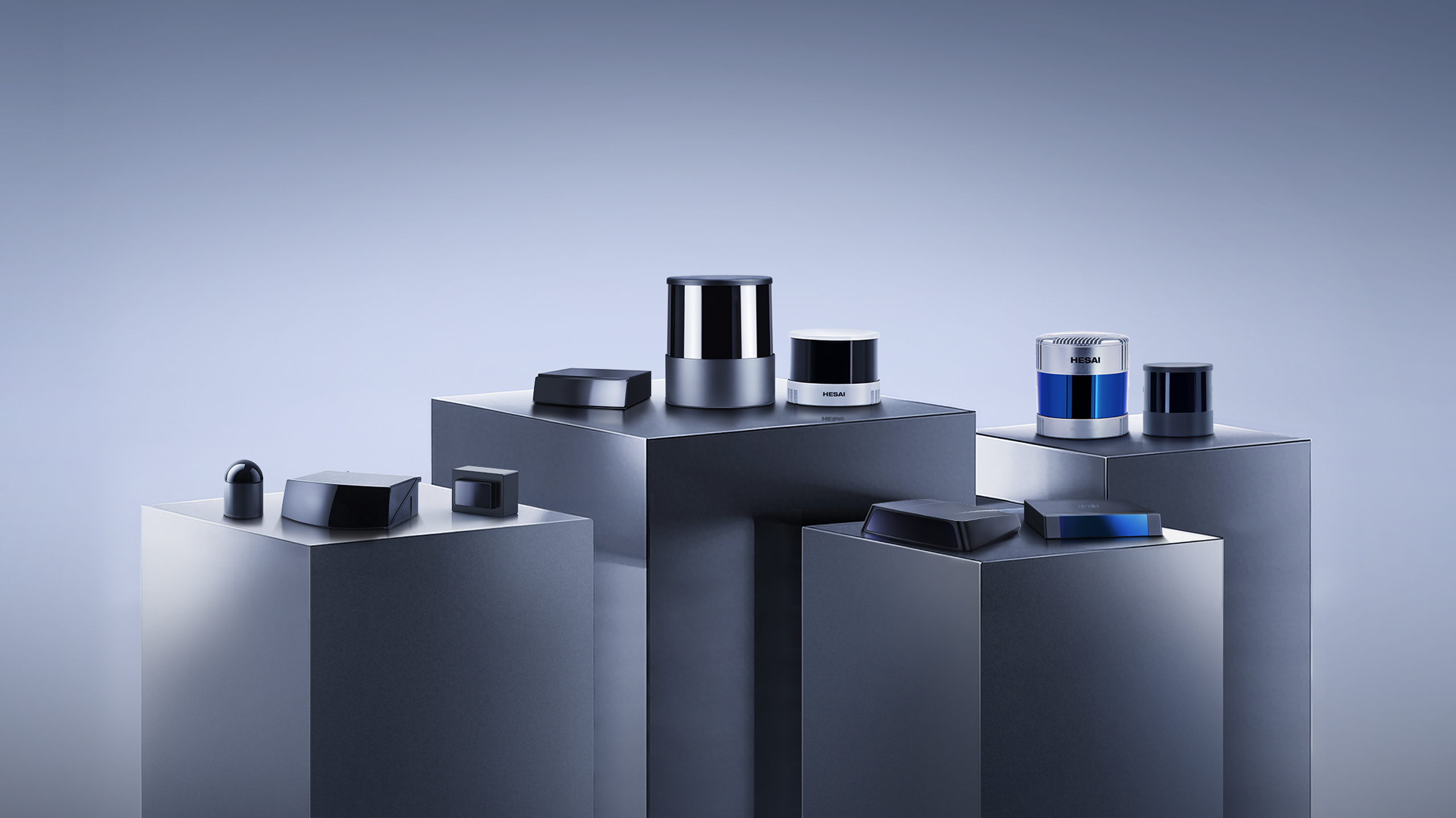
LidarSeek currently lists Hesai products including:
- Hesai JT16
- Hesai JT32
- Hesai JT64P
- Hesai JT128
- Hesai XT16
- Hesai XT32
- Hesai XT32M
- Hesai ATX
- Hesai AT128
- Hesai QT128
- Hesai FTX
- Hesai OT128
- Hesai AT1440
- Hesai ETX
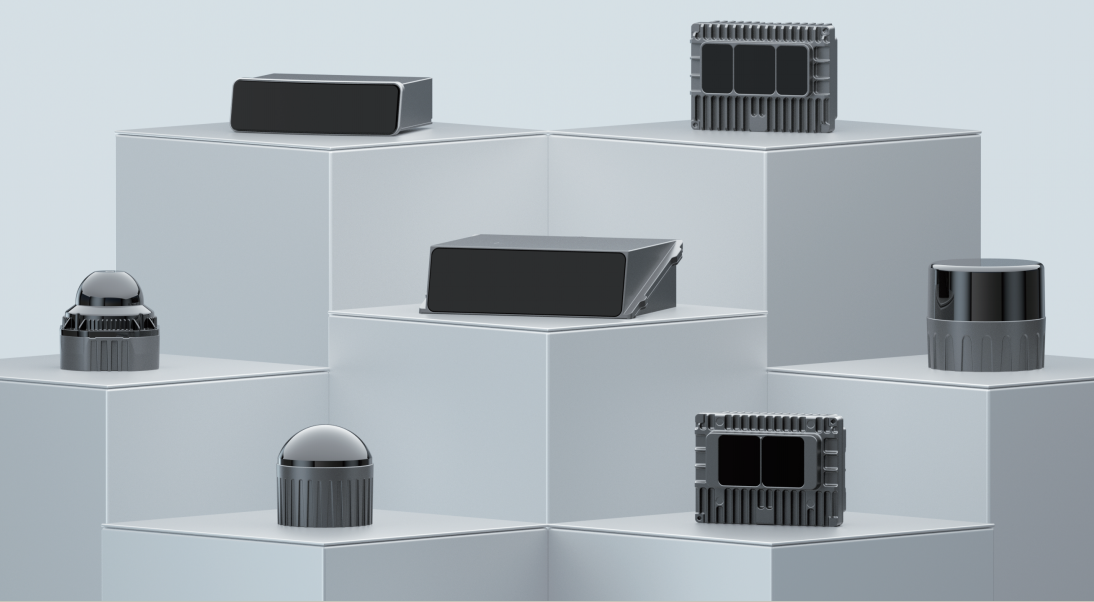
RoboSense products available through LidarSeek include:
- RoboSense RS-E1R
- RoboSense RS-Airy
- RoboSense RS-Fairy
- RoboSense RS-Helios 16
- RoboSense RS-Helios 32
- RoboSense RS-M1
- RoboSense RS-M1Plus
- RoboSense RS-M2
- RoboSense RS-MX
- RoboSense RS-EMX
- RoboSense RS-EM4
- RoboSense RS-RubyPlus128
- RoboSense Bpearl
- RoboSense AC1
The current LidarSeek catalog therefore makes it possible to compare products according to actual application requirements rather than simply comparing manufacturers.
Hesai vs RoboSense LiDAR Product Comparison
The following table provides a high-level product matching guide.
| Application | Hesai Product | RoboSense Product | Main Comparison |
|---|---|---|---|
| Small AGV / Service Robot | JT16 | E1R | Compact navigation |
| Small Robot / AGV | JT32 | Fairy | Range and point density |
| Industrial AGV | XT16 | Helios 16 | 360° industrial perception |
| Industrial Robot / Mapping | XT32 | Helios 32 | 32-line 3D perception |
| Long-Range Industrial Robot | XT32M | Helios 32 / M2 | Long-range perception |
| Compact Automotive ADAS | ATX | M1Plus | Forward automotive sensing |
| High-Performance Automotive | AT1440 / ETX | RS-EM4 | High-resolution automotive perception |
| Automotive Blind Spot | FTX | Bpearl | Wide-area short-range perception |
| High-Performance Automotive / Autonomous Driving | AT128 | RubyPlus128 / M2 | Long-range high-density perception |
| Survey / Security | OT128 | RubyPlus128 | Long-range 360° perception |
These are application-based matches, not claims that each pair is technically identical or a drop-in replacement. Final selection should always be based on the project’s required range, FOV, resolution, point rate, environmental conditions, interface, software compatibility, and mechanical integration.
1. Hesai JT16 vs RoboSense E1R
For compact robots, AGVs, AMRs, and service robots, a smaller LiDAR is often more useful than a high-end automotive sensor.
The Hesai JT16 is designed as a compact 360° 3D robot LiDAR. LidarSeek lists it with a maximum detection distance of 30 meters, 16 laser lines, 360° horizontal FOV and 40° vertical FOV.
RoboSense E1R is positioned as a compact full-solid-state LiDAR for robot navigation. LidarSeek lists a 30-meter maximum range at 10% reflectivity, 120° × 90° FOV and 260K points/s.
Specification comparison
| Parameter | Hesai JT16 | RoboSense E1R |
|---|---|---|
| Main Application | Small AGV / Service Robot | AGV / Service Robot / AMR |
| Architecture | Rotary | Full Solid-State Flash |
| Range | 30 m max | 30 m @10% reflectivity |
| Horizontal FOV | 360° | 120° |
| Vertical FOV | 40° | 90° |
| Channels | 16 | Flash array |
| Point Rate | 96K pts/s | 260K pts/s |
| Moving Parts | Yes | No |
The biggest difference is not simply range.
The JT16 provides 360° horizontal coverage, making it attractive when a robot needs continuous surrounding perception from a single sensor.
The E1R uses a solid-state flash architecture and provides a much wider vertical FOV. This can be useful when the sensor must detect obstacles across a large vertical area.
Which one should buyers consider?
For a mobile robot that needs 360° horizontal navigation, JT16 is an interesting option.
For applications prioritizing solid-state architecture, wide vertical coverage, and compact integration, RoboSense E1R may be a closer fit.
This is an example where the product with the higher point rate is not automatically the correct product. The sensor architecture and FOV can have a greater impact on system design.
2. Hesai JT32 vs RoboSense Fairy
For small and medium-sized robots, 32-line LiDARs provide more vertical information than basic 16-line sensors.
LidarSeek lists Hesai JT32 with:
- 65 m maximum detection
- 32 laser lines
- 360° horizontal FOV
- 42.6° vertical FOV
- 192K points/s
RoboSense Fairy is positioned as a higher-precision digital LiDAR for robotics and mapping. LidarSeek lists a 150 m maximum range, 360° × 30° FOV and up to 3.2M points/s.
| Parameter | Hesai JT32 | RoboSense Fairy |
|---|---|---|
| Application | Small AGV / Service Robot | Survey / Smart City / Mapping |
| Range | 65 m max | 150 m @10% reflectivity |
| Horizontal FOV | 360° | 360° |
| Vertical FOV | 42.6° | 30° |
| Channels | 32 | Dense vertical channels |
| Point Rate | 192K pts/s | Up to 3.2M pts/s |
This is not a perfect one-to-one replacement.
The JT32 is much more directly oriented toward compact mobile robots, while Fairy targets higher-precision perception, mapping, and outdoor applications.
For an indoor AMR, warehouse robot, or service robot, the JT32 may provide sufficient capability without paying for performance the system does not need.
For outdoor mapping, surveying, smart-city perception, or high-density 3D reconstruction, RoboSense Fairy belongs to a higher performance category.
3. Hesai XT16 vs RoboSense RS-Helios 16
This is one of the more straightforward comparisons.
Both products are 16-line mechanical 3D LiDAR solutions aimed at robotics and industrial applications.
LidarSeek lists the Hesai XT16 with:
- 16 laser lines
- 120 m maximum range
- 360° horizontal FOV
- 30° vertical FOV
- 320K points/s
- zero-blind-zone design
The RoboSense RS-Helios 16 is listed at up to 150 m and is designed for high-precision robot navigation and mapping.
| Parameter | Hesai XT16 | RoboSense RS-Helios 16 |
|---|---|---|
| Lines | 16 | 16 |
| Horizontal FOV | 360° | 360° |
| Application | AGV / Warehouse | Robot Navigation / Mapping |
| Range | Up to 120 m | Up to 150 m |
| Architecture | Mechanical | Mechanical |
| Typical Use | Industrial automation | Robotics / Mapping |
For buyers looking for an industrial 3D LiDAR, these two products are much more comparable than automotive LiDAR models.
Important purchasing factors include:
- Required operating range
- Point cloud density
- Indoor/outdoor deployment
- Temperature requirements
- Ethernet interface
- ROS compatibility
- Mounting dimensions
- Power consumption
- Required quantity
- Project pricing
For an indoor warehouse AGV, 120 meters may already be far beyond the actual operating requirement.
In that case, purchasing the sensor with the greatest advertised range may not produce the best overall system economics.
4. Hesai XT32 vs RoboSense RS-Helios 32
The Hesai XT32 and RoboSense RS-Helios 32 are particularly relevant for customers looking for a 32-line 360° 3D LiDAR.
LidarSeek lists XT32 as a high-precision robot LiDAR with:
- 32 laser lines
- 120 m range
- 360° horizontal FOV
- 31° vertical FOV
- 640K points/s
RoboSense Helios 32 is listed as a 16/32-beam mechanical 3D LiDAR with up to 150 m range and full 360° horizontal FOV.
| Parameter | Hesai XT32 | RoboSense Helios 32 |
|---|---|---|
| Laser Lines | 32 | 32 |
| Horizontal FOV | 360° | 360° |
| Range | Up to 120 m | Up to 150 m |
| Vertical FOV | 31° | Around 26° |
| Point Rate | 640K pts/s | Up to 1.152M pts/s |
| Application | AGV / Mapping | Outdoor Robot / Mapping |
| Interface | Ethernet | Ethernet / UDP ecosystem |
For engineers developing:
- AMRs
- Autonomous forklifts
- Outdoor robots
- Inspection robots
- Mapping robots
- Mobile mapping systems
both product families deserve consideration.
One major factor is that FOV and point rate should be evaluated together.
A larger vertical FOV can improve detection of nearby obstacles and uneven terrain, while a higher point rate can provide greater point cloud density.
5. Hesai XT32M vs RoboSense Helios 32 / M2
When the project requires substantially longer range, the comparison changes.
LidarSeek lists the Hesai XT32M with a maximum range of 300 meters, 32 laser lines, 360° × 40.3° FOV and 640K points/s.
This makes XT32M suitable for more demanding industrial and outdoor robotic applications.
RoboSense also offers higher-performance products such as Helios and M2 within its robotics and autonomous perception portfolio.
The important point for buyers is that long-range LiDAR should not be selected purely according to the maximum distance number.
For example, a 300-meter specification does not mean that every object can be detected at 300 meters under every environmental condition.
Actual performance depends on:
- Target reflectivity
- Weather
- Atmospheric conditions
- Object size
- Incidence angle
- Sensor configuration
- Detection threshold
- Data processing
Therefore, procurement teams should request the manufacturer’s detailed test conditions before using a maximum-range number as a system design specification.
6. Hesai ATX vs RoboSense RS-M1Plus
The automotive segment is where the Hesai vs RoboSense comparison becomes especially important.
LidarSeek currently lists the Hesai ATX as a compact automotive LiDAR with:
- Up to 230 m range at 10% reflectivity
- 120° horizontal FOV
- 20° vertical FOV
- Up to 3.84M points/s
- Up to 256 vertical channels
- Compact vehicle-oriented architecture
RoboSense RS-M1Plus is listed as a flash solid-state automotive LiDAR with a 100 m maximum range at 10% reflectivity and flat-panel vehicle mounting.
| Parameter | Hesai ATX | RoboSense RS-M1Plus |
|---|---|---|
| Application | Compact Vehicle ADAS | Passenger Vehicle ADAS |
| Architecture | Mini Rotational | Solid-State |
| Range | 230 m @10% | 100 m @10% |
| Horizontal FOV | 120° | Automotive forward sensing |
| Vertical FOV | 20° | — |
| Point Rate | Up to 3.84M pts/s | High-density automotive sensing |
| Integration Focus | Long-range compact perception | Flat-panel integration |
These products illustrate two different approaches.
The ATX emphasizes long-range perception and high-density sensing within a compact automotive package.
The M1Plus emphasizes solid-state architecture and vehicle integration.
For OEMs, the decision may therefore depend on whether the primary requirement is:
long-range perception
or
packaging and solid-state integration.
7. Hesai AT1440 / ETX vs RoboSense RS-EM4
At the high-performance automotive level, comparing only price becomes even less meaningful.
LidarSeek currently positions Hesai AT1440 as an automotive-grade 120° ultra-high-resolution long-range LiDAR with:
- 300 m range @10% reflectivity
- 120° × 18° FOV
- 34M points/s
- 1,440 vertical lines
- L4 robotaxi / premium EV applications
Hesai ETX is listed as a 300 m, 120° × 20° automotive LiDAR using a 1550 nm all-solid-state architecture.
RoboSense RS-EM4 is listed by LidarSeek as a mass-production-ready 520-line automotive LiDAR with a 300 m ranging distance and 25° vertical FOV.
| Parameter | Hesai AT1440 | Hesai ETX | RoboSense RS-EM4 |
|---|---|---|---|
| Range | 300 m @10% | 300 m | 300 m |
| Horizontal FOV | 120° | 120° | — |
| Vertical FOV | 18° | 20° | 25° |
| Lines | 1,440 | High-resolution fiber array | 520 |
| Point Rate | 34M pts/s | High frequency | High-resolution |
| Application | L4 / Premium EV | L3 ADAS | Autonomous Vehicles |
At this level, procurement should evaluate more than range.
Important factors include:
- Horizontal resolution
- Vertical resolution
- Point density
- ROI scanning
- Detection probability
- Reflectivity performance
- Thermal management
- Automotive qualification
- Functional safety requirements
- Vehicle packaging
- Software ecosystem
- Production availability
- OEM integration support
For an automotive OEM, the correct LiDAR is ultimately the product that satisfies the complete system specification rather than the one with the largest specification number.
8. Hesai OT128 vs RoboSense RubyPlus128
For long-range 360° perception, Hesai OT128 and RoboSense RubyPlus128 are another interesting comparison.
LidarSeek lists Hesai OT128 as a high-performance 128-line LiDAR for survey and security applications:
- 200 m range
- 360° × 40° FOV
- 3.456M points/s
- 128 physical lines
RoboSense RubyPlus128 is positioned as a 128-line LiDAR for L4 commercial operation, with up to 200 m range, 360° × 40° FOV and up to 9.216M points/s in high-performance mode.
| Parameter | Hesai OT128 | RoboSense RubyPlus128 |
|---|---|---|
| Lines | 128 | 128 |
| Range | 200 m | 200 m @10% |
| Horizontal FOV | 360° | 360° |
| Vertical FOV | 40° | 40° |
| Point Rate | 3.456M pts/s | Up to 9.216M pts/s |
| Primary Application | Survey / Security | Robotaxi / Bus / Truck |
The applications are not identical.
OT128 is positioned strongly toward survey, security, ports, border protection, and perimeter monitoring, while RubyPlus128 is positioned toward commercial autonomous driving.
Therefore, this comparison is useful for customers evaluating high-density 128-line LiDAR, but application requirements must remain the primary selection criterion.
10. Hesai vs RoboSense LiDAR Price Comparison
Price is one of the most important considerations for international LiDAR buyers.
However, LiDAR pricing changes according to:
- Model
- Order quantity
- Project stage
- Development samples
- Production volume
- Shipping terms
- Technical support
- Configuration
- Warranty
- Integration requirements
LidarSeek currently displays indicative prices for multiple Hesai and RoboSense models. For example, its Hesai catalog lists JT16 at around $450, JT32 at around $620, JT64P/JT128 around $900, XT16 around $1,769, XT32 around $3,448, XT32M around $6,200, ATX around $1,790 and AT128 around $2,060.
The RoboSense brand catalog currently displays examples including RS-Airy around $672, RS-E1R around $664, RS-Fairy around $1,299, RS-Helios 16 around $1,645, RS-Helios 32 around $2,010, RS-M1Plus around $2,090, RS-M2 around $1,730, RS-EMX around $2,239 and RS-EM4 around $5,373.
These website prices should be treated as indicative pricing rather than a guaranteed commercial quotation.
For OEM and bulk orders, buyers should request a project-specific quotation.
11. Which Is Cheaper: Hesai or RoboSense?
There is no single answer.
The cheaper sensor depends on the exact model and specification.
For example, comparing a $450 16-line robot LiDAR with a $5,000+ automotive LiDAR would not provide a meaningful conclusion.
Instead, buyers should compare products within the same application category.
A better procurement method is:
Step 1: Define the application
Is the sensor for:
- AGV?
- AMR?
- Humanoid robot?
- Robot dog?
- Autonomous forklift?
- Autonomous vehicle?
- ADAS?
- Mapping?
- Survey?
- Security?
Step 2: Define the minimum range
Do you actually need:
- 30 m?
- 60 m?
- 100 m?
- 150 m?
- 200 m?
- 300 m?
Step 3: Define FOV
Determine whether you need:
- Forward-facing 120°
- 140° blind-zone coverage
- 360° horizontal coverage
- Wide vertical coverage
Step 4: Define point density
Do you need:
- 16 lines?
- 32 lines?
- 64 lines?
- 128 lines?
- 500+ equivalent lines?
- 1,000+ lines?
Step 5: Calculate total system cost
Consider:
LiDAR price + mounting + computing + cables + software + integration + maintenance + replacement cost
This provides a much more realistic procurement comparison than the sensor purchase price alone.
12. Hesai vs RoboSense: Mechanical LiDAR or Solid-State LiDAR?
Another important consideration is architecture.
Mechanical LiDAR can provide:
- 360° scanning
- Wide environmental coverage
- Mature 3D point cloud generation
- Strong suitability for mapping and mobile robotics
Solid-state LiDAR can provide:
- No conventional rotating scanning mechanism
- Compact packaging
- Automotive integration advantages
- Potentially simpler mechanical integration
For example, Hesai JT16, JT32, XT16 and XT32 are mechanical/rotary products in the LidarSeek portfolio, while products such as Hesai FTX use a solid-state flash architecture.
RoboSense similarly offers both mechanical products such as Helios and solid-state products such as E1R and M1Plus.
Therefore, comparing architecture can be more important than comparing brand.
13. Hesai vs RoboSense for Robotics
For robotics projects, the following product groups are particularly relevant.
| Robot Application | Hesai Options | RoboSense Options |
|---|---|---|
| Small Service Robot | JT16 | E1R |
| AMR | JT32 / JT64P / JT128 | E1R / Fairy |
| Autonomous Forklift | XT16 / XT32 | Helios 16 / Helios 32 |
| Outdoor Robot | XT32 / XT32M | Helios / M2 |
| Mapping Robot | XT32 / OT128 | Fairy / Helios / RubyPlus |
| Humanoid Robot | JT128 / ATX | E1R / Airy / Fairy |
| Robot Dog | JT32 / JT64P | E1R / Airy |
| Industrial Inspection | XT16 / XT32 | Helios |
For humanoid robots and embodied AI, compact sensors with wide FOV can be particularly useful.
For autonomous forklifts and industrial AGVs, 360° coverage and stable Ethernet point-cloud output are often more important.
For mapping robots, range, angular resolution, point density, and calibration become increasingly important.
14. Hesai vs RoboSense for Automotive LiDAR
Automotive applications require a different evaluation methodology.
Relevant Hesai products include:
- ATX
- AT128
- AT1440
- ETX
- FTX
- QT128
RoboSense provides:
- M1
- M1Plus
- M2
- MX
- EMX
- EM4
- RubyPlus128
- Bpearl
The product selection depends on whether the vehicle requires:
Forward perception
Surround perception
Blind-spot detection
Long-range highway perception
or
High-density autonomous driving perception.
For example, ATX is listed as a compact long-range automotive LiDAR, while M1Plus is positioned as a solid-state passenger-vehicle LiDAR.
For higher-end perception, products such as Hesai AT1440 and RoboSense RS-EM4 represent much higher-performance categories.
15. How to Choose Between Hesai and RoboSense
Instead of asking:
“Is Hesai better than RoboSense?”
A more useful engineering question is:
“Which specific LiDAR meets my application’s minimum technical requirements at the lowest practical total project cost?”
Use the following checklist.
Range
Select the minimum range required by your application.
Do not automatically choose 300 m if the robot only operates inside a 30-meter environment.
FOV
Determine whether you need 120°, 140°, 180°, or 360° coverage.
Resolution
Higher resolution may improve detection of small objects, but it can also increase data processing requirements.
Point Rate
A higher point rate can provide denser point clouds but may require higher network bandwidth and computing performance.
Size
Vehicle integration and compact robot platforms may have strict space limitations.
Weight
Weight can be important for UAVs, humanoid robots, mobile robots, and compact autonomous platforms.
Power
Battery-powered robots should pay particular attention to power consumption.
Interface
Check Ethernet, UDP packet format, synchronization, ROS compatibility, SDK support, and integration documentation.
Environment
Check:
- Operating temperature
- Storage temperature
- IP rating
- Rain
- Dust
- Sunlight
- Vibration
Price
Compare actual project quotation rather than relying only on list prices.
16. Why Buy Hesai and RoboSense LiDAR from LidarSeek?
For international customers, purchasing is not only about identifying the correct model.
Procurement teams also need to consider:
- Product availability
- International shipping
- Technical support
- Product comparison
- Bulk pricing
- Replacement units
- Communication with suppliers
- Project-specific quotations
LidarSeek focuses on supplying LiDAR sensors and intelligent perception solutions for autonomous driving, robotics, industrial automation, mapping, and AI applications.
The website provides both Hesai and RoboSense product catalogs, allowing buyers to compare different models rather than being limited to a single manufacturer.
LidarSeek also emphasizes affordable LiDAR sensors, factory-direct pricing, and competitive bulk rates, which is particularly relevant for robotics companies, system integrators, universities, R&D teams, and OEM projects.
For customers purchasing multiple LiDAR units, requesting a project quotation can be more useful than relying on a standard online price.
17. Recommended Hesai vs RoboSense Product Matching Table
For a quick purchasing reference:
| Your Requirement | Hesai Model to Consider | RoboSense Model to Consider | Key Evaluation |
|---|---|---|---|
| Low-cost compact robot | JT16 | E1R | Size / FOV / architecture |
| 32-line robot perception | JT32 | Fairy | Range / point density |
| Industrial AGV | XT16 | Helios 16 | 360° coverage |
| 32-line industrial LiDAR | XT32 | Helios 32 | Range / point rate |
| Long-range industrial | XT32M | Helios / M2 | Long-distance perception |
| Compact automotive | ATX | M1Plus | Range / integration |
| Automotive high resolution | AT1440 | EM4 | Resolution / point density |
| Automotive blind spot | FTX | Bpearl | FOV / packaging |
| 128-line perception | OT128 | RubyPlus128 | Point rate / application |
| Autonomous vehicle | ATX / AT128 / ETX | M2 / EMX / EM4 | Automotive integration |
Again, these are comparison starting points rather than direct replacement recommendations. The final model should be selected from the project’s technical requirements.
18. Frequently Asked Questions About Hesai vs RoboSense LiDAR
FAQ 1: Is Hesai LiDAR better than RoboSense LiDAR?
There is no universal answer.
Hesai and RoboSense have different product families covering automotive, industrial, robotics, mapping, and blind-spot applications.
The correct choice depends on range, FOV, resolution, point rate, architecture, environmental requirements, integration, and price.
FAQ 2: Which Hesai LiDAR is similar to RoboSense Helios 32?
Hesai XT32 is one of the closest application-level comparisons.
Both are 32-line 360° mechanical 3D LiDAR products used for robotics, industrial automation, mapping, and autonomous systems.
The exact specifications should be checked before selecting one for a production system.
FAQ 3: Which RoboSense LiDAR is similar to Hesai XT16?
RoboSense RS-Helios 16 is a natural product to evaluate.
Both products target 16-line 360° 3D perception applications.
The final selection should consider range, vertical FOV, point rate, environmental rating, software compatibility, and project price.
FAQ 4: Which Hesai LiDAR is similar to RoboSense M1Plus?
Hesai ATX is a useful comparison for compact automotive LiDAR applications.
However, the two sensors use different architectures and should not be treated as direct hardware replacements.
FAQ 5: What is the difference between Hesai ATX and RoboSense M1Plus?
The LidarSeek catalog lists ATX with a 230 m maximum range at 10% reflectivity, 120° × 20° FOV and up to 3.84M points/s.
RoboSense M1Plus is listed as a solid-state automotive LiDAR with a 100 m maximum range at 10% reflectivity.
The comparison therefore involves not only range but also architecture and vehicle integration.
FAQ 6: Is a 128-line LiDAR always better than a 32-line LiDAR?
No.
A 128-line sensor can provide significantly denser vertical information, but it may also have higher cost, bandwidth requirements, processing requirements, and power consumption.
For many AGVs and warehouse robots, a 16- or 32-line sensor can be sufficient.
FAQ 7: Which LiDAR is best for an autonomous forklift?
Industrial 3D LiDARs such as Hesai XT16/XT32 and RoboSense Helios 16/32 are relevant products to evaluate.
The final selection depends on warehouse size, obstacle height, required range, mounting height, environmental conditions, and navigation software.
FAQ 8: Which LiDAR is suitable for a humanoid robot?
Compact, wide-FOV sensors can be particularly useful for humanoid robots.
Potential products to investigate include Hesai JT128 and ATX, as well as RoboSense E1R, Airy, and Fairy, depending on the robot’s size and sensing requirements.
FAQ 9: How much does Hesai LiDAR cost?
LidarSeek currently lists Hesai products at different price levels.
For example, its website currently lists JT16 around $450, JT32 around $620, XT16 around $1,769, XT32 around $3,448, XT32M around $6,200, ATX around $1,790 and AT128 around $2,060.
Prices can change, and bulk or OEM pricing may be different.
FAQ 10: How much does RoboSense LiDAR cost?
LidarSeek currently lists different RoboSense products at different price levels.
Examples include RS-E1R around $664, RS-Airy around $672, RS-Fairy around $1,299, RS-Helios 16 around $1,645, RS-Helios 32 around $2,010, RS-M1Plus around $2,090, RS-M2 around $1,730 and RS-EM4 around $5,373.
For larger orders, buyers should request a current quotation.
FAQ 11: Can I buy both Hesai and RoboSense LiDAR from LidarSeek?
Yes. LidarSeek currently maintains product catalogs for both Hesai and RoboSense and provides product comparison and quotation options.
FAQ 12: Can LidarSeek help me select a LiDAR?
Yes.
LidarSeek provides LiDAR solution consulting for applications including autonomous driving, industrial automation, robotics, mapping, and intelligent perception.
If you provide your required range, FOV, application, quantity, operating environment, and target budget, a suitable product shortlist can be prepared.
Conclusion: Hesai vs RoboSense Is a Model-Level Decision
The comparison between Hesai and RoboSense should not be reduced to a simple brand-versus-brand question.
Both manufacturers provide LiDAR products covering multiple technical architectures and application categories.
For compact robotics, products such as Hesai JT16/JT32 and RoboSense E1R/Fairy can be compared according to range, FOV, point rate, size, and integration.
For industrial robotics, Hesai XT16/XT32/XT32M and RoboSense Helios series provide useful comparison points.
For automotive applications, Hesai ATX, AT128, AT1440 and ETX can be evaluated alongside RoboSense M1Plus, M2, EMX, EM4 and RubyPlus128, depending on the required performance level.
For blind-spot perception, Hesai FTX and RoboSense Bpearl provide another application-specific comparison.
The most important purchasing principle is simple:
Do not buy the highest specification LiDAR simply because it has the highest specification.
Instead, identify the minimum technical requirements of your project and then compare:
Performance + Integration + Reliability + Availability + Price + Total Project Cost
For international LiDAR buyers, LidarSeek provides access to both Hesai LiDAR and RoboSense LiDAR, along with product specifications, comparison information, quotation support, and bulk purchasing options.
If you are evaluating multiple models, the fastest approach is to send LidarSeek your application, required detection range, FOV, quantity, and target price. The appropriate Hesai and RoboSense models can then be compared according to your actual project requirements.
Looking for affordable LiDAR sensors with competitive manufacturer-direct pricing? Compare Hesai and RoboSense LiDAR products on LidarSeek and request a project quotation before placing your order.









