
Introduction
Autonomous mobile robots are becoming increasingly common in warehouses, factories, logistics centers, distribution facilities and industrial environments. As these systems move from simple point-to-point automation toward more intelligent autonomous navigation, their perception systems must become more capable as well.
An AMR does not simply need to know how far away an obstacle is. It needs to understand the surrounding environment, identify free space, detect people and equipment, estimate the position of objects and continuously update its navigation decisions.
This is why LiDAR has become an important sensing technology for modern AGV and AMR platforms.
However, choosing a LiDAR for a mobile robot is not simply a matter of selecting the sensor with the longest range. For many robots, field of view, minimum detection distance, point density, update frequency, physical size and power consumption can be more important than maximum range.
This is where the Seyond Robin W becomes particularly interesting.
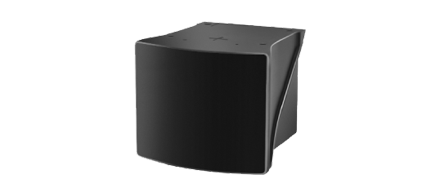
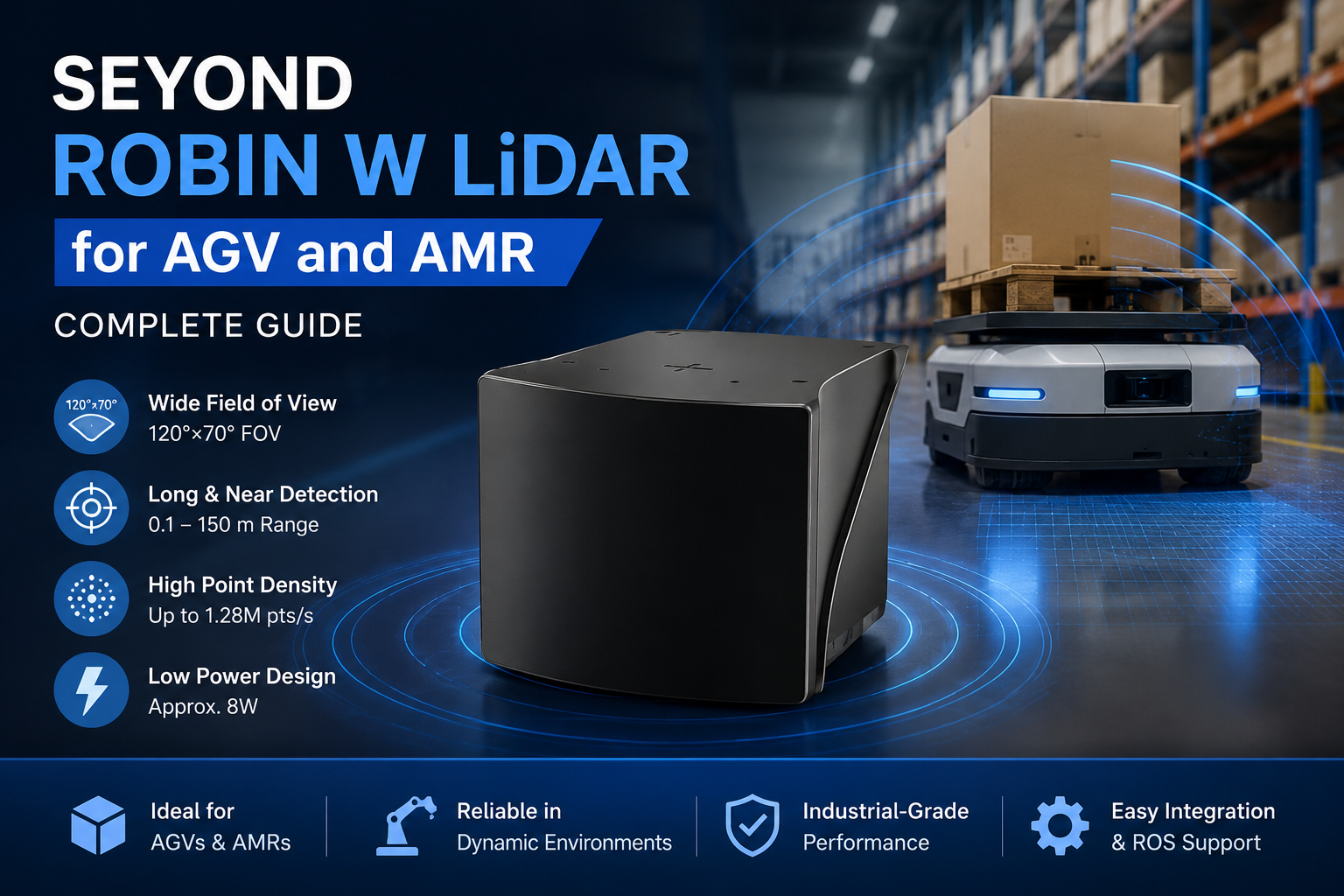
According to the current LidarSeek product information, Robin W is designed around an ultra-wide 120° × 70° horizontal and vertical field of view, with a detection range of approximately 0.1–150 meters, including up to 70 meters at 10% reflectivity. The sensor uses 192 scan lines, supports up to 1.28 million points per second, and provides multiple frame-rate options.
For AGV and AMR developers, these characteristics create an interesting combination: broad environmental coverage, short minimum detection distance and relatively high point-cloud density in a compact sensor.
This guide explains how Robin W can fit into an autonomous robot perception architecture, what makes wide-angle LiDAR valuable, and what engineers should consider before purchasing.
1. Why AGVs and AMRs Need More Than Long-Range LiDAR
A common assumption in LiDAR selection is that a longer detection range automatically means a better sensor.
That assumption does not always apply to mobile robots.
Consider an AMR operating inside a warehouse.
The robot may encounter:
- Storage racks
- Pallets
- Workers
- Forklifts
- Boxes
- Other robots
- Safety barriers
- Narrow corridors
- Loading areas
- Temporary obstacles
Most of these objects may be located relatively close to the robot.
A sensor capable of detecting an object hundreds of meters away may provide little additional value if the robot is moving through a 10-meter-wide warehouse corridor.
Instead, the robot may benefit more from:
- Wide horizontal coverage
- Large vertical coverage
- Short minimum detection distance
- High point density
- Fast updates
- Stable operation
- Easy mechanical integration
This changes how LiDAR should be evaluated.
For an industrial robot, the question should not simply be:
“How far can this LiDAR see?”
A better question is:
“How effectively can this LiDAR cover the robot’s operational environment?”
2. What Makes the Robin W Different?
The most distinctive specification of Robin W is its field of view.
LidarSeek currently lists a 120° × 70° FOV for Robin W.
This is important because mobile robots operate in three dimensions.
A narrow vertical field of view can create difficulties when objects exist at different heights.
For example, an AMR may encounter:
- A low pallet
- A person’s legs
- A cart
- A forklift
- A shelf
- An overhead structure
A larger vertical field of view gives the perception system more information about the environment.
The 120° horizontal field of view is also valuable.
A robot does not always move through a completely open environment. When navigating near shelves, walls or other robots, a large horizontal coverage area can reduce the need for additional sensors.
3. Why Wide-Angle LiDAR Matters for AMR Navigation
Imagine a mobile robot equipped with a LiDAR that only covers a narrow forward-facing area.
The robot may need to turn frequently to inspect its surroundings.
Alternatively, developers may need to install multiple sensors around the robot.
Both approaches can increase system complexity.
A wide-angle sensor can provide a larger perception area from a single mounting position.
For some robot architectures, this can simplify:
- Sensor placement
- Mechanical design
- Wiring
- Point-cloud processing
- Calibration
- Maintenance
- BOM cost
This does not mean one wide-angle LiDAR can replace every sensor in every robot.
Camera systems, IMUs, wheel encoders and additional LiDARs may still be required.
However, a wide-FOV LiDAR can become an important part of the perception layer.
4. Minimum Detection Distance Is Important for Small Robots
Another important Robin W characteristic is the minimum detection distance.
LidarSeek lists the Robin W range as approximately 0.1 m to 150 m, with 70 m at 10% reflectivity.
For an AMR, the ability to detect objects close to the vehicle can be highly valuable.
Imagine a small object positioned immediately beside the robot.
If the sensor has a significant blind area, the robot may not detect it until the object moves into a more favorable sensing region.
A short minimum detection distance can help perception algorithms maintain awareness of nearby objects.
This is especially relevant to:
- Warehouse AMRs
- Autonomous carts
- Indoor logistics robots
- Service robots
- Industrial mobile platforms
For these applications, near-field perception can be as important as long-range detection.
5. 192 Scan Lines and Point Cloud Density
LidarSeek lists Robin W with 192 scan lines and up to 1.28 million points per second.
Point density matters because autonomous navigation depends on the quality of spatial information available to software.
A denser point cloud can help algorithms identify:
- Edges
- Obstacles
- Object surfaces
- Narrow structures
- Free-space boundaries
- Environmental geometry
For example, consider a warehouse aisle containing thin structures.
A low-density point cloud may provide only a few measurements from an object.
A higher-density point cloud can provide more geometric information.
This can potentially improve downstream perception algorithms.
Of course, point count alone should never be treated as a complete measure of LiDAR quality.
Engineers should also examine:
- Angular resolution
- Range accuracy
- Reflectivity performance
- Point distribution
- Return behavior
- Timing
- Interface
- Environmental specifications
6. Robin W for AGV Applications
AGVs have traditionally followed predefined paths.
However, modern industrial automation is increasingly moving toward autonomous navigation.
An AGV equipped with LiDAR can potentially become more flexible.
For example, instead of relying exclusively on fixed magnetic tracks, the system can use environmental information for navigation and obstacle detection.
Robin W may be considered for applications such as:
Warehouse AGVs
Warehouse vehicles need to detect:
- Pallets
- Workers
- Racks
- Other vehicles
- Temporary obstacles
Wide-angle perception can be useful in these environments.
Factory Logistics Vehicles
Manufacturing facilities often contain moving equipment, operators and changing production layouts.
LiDAR can provide an additional spatial sensing layer.
Autonomous Forklift Systems
Forklifts operate in environments where obstacles may exist at multiple heights and distances.
A large vertical FOV can provide useful environmental information.
Mobile Inspection Robots
Inspection platforms may move close to walls, machinery and infrastructure.
Short-range perception is therefore important.
7. Robin W for AMR Navigation
AMRs require continuous environmental understanding.
A typical perception architecture might look like:
LiDAR → Point Cloud → Perception → Localization → Path Planning → Motion Control
Robin W can serve as the primary 3D sensing component in such an architecture.
The LiDAR generates spatial measurements.
The software then processes the point cloud for:
- Localization
- Mapping
- Obstacle detection
- Free-space estimation
- Navigation
- Collision avoidance
The exact software architecture depends on the robot platform.
Developers may integrate the sensor with ROS or other robotics middleware. LidarSeek also states that its listed products support ROS systems and mainstream development integration platforms for secondary development.
8. Using Robin W with Cameras
LiDAR does not need to operate alone.
Many modern robots combine:
- LiDAR
- RGB cameras
- Depth cameras
- IMU
- Wheel encoders
- GNSS where applicable
Each sensor provides different information.
A camera can provide rich visual information.
LiDAR provides geometric distance information.
An IMU provides motion information.
Wheel encoders provide movement estimates.
When these data sources are fused, the robot can develop a more complete understanding of its environment.
For example:
Camera: What does the object look like?
LiDAR: Where is the object?
IMU: How is the robot moving?
Encoder: How far has the robot travelled?
Sensor fusion can therefore be more powerful than relying on a single sensor.
9. Power Consumption and Robot Design
Power consumption is another important consideration for mobile platforms.
LidarSeek’s Robin W product information describes a low-power design with approximately 8W overall power consumption.
For a stationary industrial machine, power consumption may not be a major issue.
For a battery-powered AMR, however, every watt matters.
A lower-power sensing system can potentially contribute to:
- Longer operating time
- Smaller battery requirements
- Lower heat generation
- Easier thermal management
- Greater mechanical flexibility
The impact becomes even more significant when a robot uses multiple sensors.
For example, if a platform uses four LiDAR sensors, the total sensor power budget becomes much more important than the consumption of a single unit.
10. Mechanical Integration
A LiDAR can have excellent specifications and still be unsuitable for a robot if it is difficult to integrate.
Robin W is described as having a compact design suitable for integration into areas such as side panels and bumpers.
For robotics developers, mechanical integration should be evaluated early.
Important questions include:
- Where will the sensor be mounted?
- Does the mounting position obstruct the FOV?
- Is vibration isolation required?
- Is the sensor exposed to dust?
- Is there enough space for cables?
- Is the sensor protected from accidental impact?
- Does the robot require a protective cover?
A wide FOV is only useful if the mechanical structure does not block it.
11. What About Indoor vs Outdoor Robots?
Robin W can be considered for different environments, but engineers should always verify the exact environmental specification for their deployment.
Indoor applications may include:
- Warehouses
- Factories
- Distribution centers
- Shopping facilities
- Research laboratories
Outdoor applications may include:
- Yard logistics
- Autonomous transport
- Agricultural environments
- Industrial sites
Outdoor deployments introduce additional variables:
- Rain
- Dust
- Sunlight
- Temperature
- Water exposure
- Vibration
Therefore, environmental qualification should be part of the purchasing process.
12. Robin W and ROS Integration
Robotics developers frequently want access to raw or processed point-cloud data.
ROS and ROS 2 have become important development environments for robotics.
A LiDAR integration workflow can include:
- Sensor connection
- Network configuration
- Driver installation
- Point-cloud publication
- Coordinate transformation
- Visualization
- SLAM
- Navigation
- Obstacle avoidance
Before purchasing, developers should confirm:
- ROS version
- Driver availability
- SDK
- Data protocol
- Ethernet requirements
- Time synchronization
- Coordinate conventions
This is especially important for production deployments.
13. How Much Does Seyond Robin W Cost?
LidarSeek currently lists the Seyond Robin W at approximately $1,725, although displayed pricing can change according to promotions, inventory and order quantity.
For engineering teams, the listed price can be useful during the early BOM planning stage.
However, the final procurement cost should consider:
Sensor + cables + mounting + shipping + integration + software + engineering
For larger orders, buyers should request a project quotation rather than assuming the displayed retail price will be the final production price.
LidarSeek currently indicates sample-order lead times of approximately 3–10 days and standard orders of 7–15 days, subject to project conditions.
14. How to Evaluate Robin W Before Purchasing
A good evaluation process should include at least five stages.
Stage 1: Define the environment
Identify:
- Indoor or outdoor
- Maximum speed
- Typical obstacle distance
- Lighting conditions
- Dust and weather
- Robot dimensions
Stage 2: Define perception requirements
Determine:
- Required FOV
- Detection range
- Minimum detection distance
- Point density
- Frame rate
Stage 3: Define integration requirements
Check:
- Mechanical dimensions
- Power
- Ethernet
- ROS support
- Time synchronization
Stage 4: Test a sample
Do not move directly from specification comparison to mass production.
Run real-world tests.
Stage 5: Evaluate production economics
Consider:
- Unit price
- Quantity
- Shipping
- Replacement
- Integration cost
- Long-term availability
15. Who Should Consider Seyond Robin W?
Robin W may be particularly relevant for organizations developing:
- AMRs
- AGVs
- Warehouse robots
- Autonomous forklifts
- Industrial mobile robots
- Service robots
- Mobile inspection systems
- Intelligent logistics platforms
Its combination of wide FOV, short minimum detection distance, high point rate and compact design makes it particularly interesting when broad environmental awareness is a major requirement.
Conclusion
Choosing a LiDAR for an autonomous mobile robot requires more than comparing maximum range.
For many AGV and AMR applications, the most important characteristics are the ability to perceive nearby objects, maintain wide environmental coverage and provide enough point-cloud information for navigation algorithms.
The Seyond Robin W is particularly interesting because of its 120° × 70° FOV, 192 scan lines, up to 1.28 million points per second and approximately 0.1-meter minimum detection distance.
For robotics teams evaluating a new perception architecture, Robin W can be considered as part of a broader LiDAR-camera-IMU sensing system.
The right choice ultimately depends on the robot’s environment, speed, mounting position, software architecture and production requirements.
If you are evaluating Robin W for an AMR, AGV or industrial robot, it is worth testing the sensor in the actual operating environment before committing to a production quantity.
Frequently Asked Questions
1. What is Seyond Robin W?
Seyond Robin W is a wide-angle LiDAR designed for spatial perception applications. LidarSeek lists it with a 120° × 70° FOV and up to 1.28 million points per second.
2. Is Robin W suitable for AMRs?
It can be a strong candidate for AMRs that require broad environmental perception, particularly where side coverage and near-field detection are important.
3. What is the Robin W detection range?
LidarSeek currently lists approximately 0.1–150 meters, with 70 meters at 10% reflectivity.
4. What is the Robin W field of view?
The listed field of view is 120° horizontal × 70° vertical.
5. How many scan lines does Robin W have?
The product page lists 192 scan lines.
6. How many points per second can Robin W generate?
The product page lists up to approximately 1.28 million points per second.
7. Is Robin W suitable for AGVs?
Yes, it can be considered for AGVs requiring wide-area 3D perception, obstacle detection and autonomous navigation.
8. Does Robin W support ROS?
LidarSeek states that its listed product is compatible with ROS systems and mainstream development integration platforms.
9. What is the price of Robin W?
LidarSeek currently lists a sale price of approximately $1,725. Actual project pricing may vary.
10. Can I purchase a sample?
LidarSeek currently indicates sample orders can have a lead time of approximately 3–10 days, subject to availability.
11. Can Robin W be used with cameras?
Yes. LiDAR-camera fusion is a common architecture for autonomous robots, although the exact integration depends on the robot’s software and hardware design.
12. How should I buy Robin W for a robot project?
Provide the robot type, required quantity, operating environment, expected speed, mounting position and software platform when requesting a quotation. This allows the supplier to recommend the appropriate configuration and commercial terms.









