
The Shift From Seeing to Understanding
The robotics industry is entering a new era. For years, cameras dominated machine perception because they were affordable and easy to deploy. Today, however, engineers developing Autonomous Mobile Robots (AMRs), warehouse automation systems, digital construction platforms, smart city infrastructure, and autonomous vehicles face a new challenge: environmental understanding.
Machines no longer need to simply see objects—they must understand distances, shapes, movement trajectories, and spatial relationships in real time.
This transition is fueling explosive demand for advanced 3D LiDAR sensors.
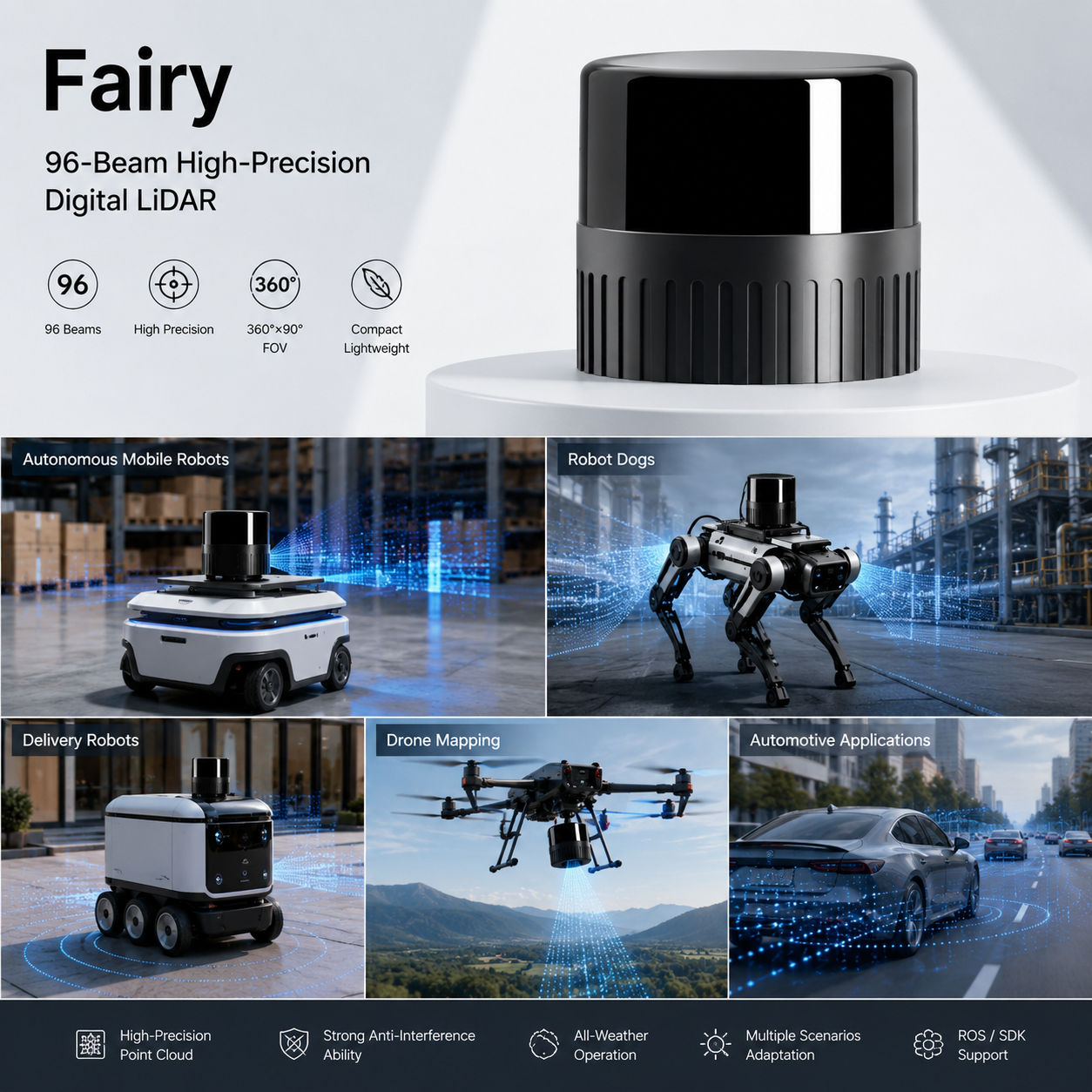
Among the latest innovations driving this trend is the RoboSense Fairy 96-Beam High-Precision Digital LiDAR, a compact yet extremely powerful sensor designed for next-generation robotic perception, autonomous navigation, dense mapping, and intelligent environmental reconstruction. Featuring a 360° × 32° field of view, up to 96 beams, approximately 1.37 million points per second, and industry-leading 0.5 cm ranging precision, Fairy represents a significant step toward digital perception systems optimized for robots and intelligent machines.
RoboSense Fairy on an Autonomous Mobile Robot

Why Autonomous Mobile Robots Are Demanding Higher Point Cloud Density
The first generation of AMRs relied heavily on 2D LiDAR and vision-based navigation. While these approaches remain useful, they struggle when robots encounter:
- irregular obstacles
- hanging objects
- dynamic human traffic
- pallets at varying heights
- changing warehouse layouts
Modern robots need richer environmental data.
This is where the RoboSense Fairy stands apart.
With approximately 1.37 million points per second in the 96-beam version and a high-resolution digital architecture, Fairy produces structured point clouds that are highly optimized for robotic algorithms. The sensor can accurately identify the dimensions, position, and movement of surrounding objects, providing robots with an exceptional level of situational awareness.
Unlike traditional perception systems that rely primarily on image interpretation, high-density point clouds allow robots to make decisions based on measurable spatial information.
For warehouse operators deploying hundreds of Autonomous Mobile Robots, this translates into:
- safer navigation
- fewer collisions
- improved route planning
- higher operational uptime
- more efficient fleet management

The New Competitive Advantage: Seamless Integration
One topic that has become increasingly important among robotics developers is integration complexity.
Historically, deploying LiDAR often required:
- extensive calibration
- external synchronization hardware
- large mounting spaces
- custom software adaptation
These challenges slowed project timelines.
The RoboSense Fairy was designed differently.
Its compact dimensions (approximately φ75 × H70 mm), lightweight construction under 350 grams, integrated IMU, and digital architecture make deployment significantly easier for robotics manufacturers and system integrators.
This enables seamless integration into:
- Autonomous Mobile Robots
- Service Robots
- Inspection Robots
- Delivery Robots
- Warehouse AGVs
- UAV Mapping Platforms
- Smart Infrastructure Systems
For companies seeking to buy LiDAR sensor solutions that can be deployed rapidly, minimizing engineering effort often becomes just as important as detection range.
Explore more industrial LiDAR solutions:

Why Digital Buildings Need Digital LiDAR
A surprising trend is emerging in the Architecture, Engineering, and Construction (AEC) industry.
Digital buildings are becoming the foundation of smart cities.
Building owners increasingly demand:
- digital twins
- BIM validation
- facility management models
- indoor navigation systems
- lifecycle asset management
Traditional surveying methods cannot efficiently capture the amount of spatial information required.
High-precision digital LiDAR is becoming the bridge between physical structures and digital infrastructure.
With its extremely high ranging precision and dense point cloud generation capabilities, RoboSense Fairy helps create highly detailed 3D models suitable for digital building applications.
The result is more accurate:
- floor plans
- structural measurements
- facility documentation
- maintenance planning
- renovation workflows


The Overlooked Role of LiDAR in Smart Logistics
Warehouse automation is growing faster than almost any other robotics sector.
However, many companies still underestimate how perception quality affects logistics efficiency.
A robot that navigates 2% more efficiently can save thousands of labor hours annually across large facilities.
The combination of:
- 360° coverage
- high beam count
- dense point clouds
- integrated IMU
allows Fairy-equipped robots to continuously update their understanding of the environment while moving.
This enables smoother navigation through:
- narrow aisles
- crowded fulfillment centers
- mixed human-robot environments
- high-density storage zones

Automotive LiDAR Is Expanding Beyond Passenger Vehicles
When most people hear “automotive LiDAR sensor,” they think about self-driving cars.
The reality is far broader.
Automotive-grade perception technologies are increasingly being adopted by:
- autonomous delivery vehicles
- industrial transport platforms
- mining equipment
- agricultural robots
- airport service vehicles
These environments demand:
- long detection ranges
- high reliability
- operation in rain and fog
- accurate object classification
Fairy’s active illumination technology allows stable operation regardless of ambient lighting conditions, making it highly suitable for these demanding scenarios.


Why Dense Point Clouds Matter More Than Maximum Range
Many buyers evaluate sensors by asking:
“How far can it see?”
The better question is:
“How much can it understand?”
A sensor that sees 300 meters but provides sparse data may be less useful than a sensor producing dense, structured point clouds.
Fairy generates approximately 1.37 million points per second in the 96-beam configuration, allowing detection of small objects, structural edges, and subtle environmental details that lower-density systems may miss.
For SLAM systems, dense point clouds directly improve:
- localization accuracy
- map quality
- obstacle recognition
- route planning


Recommended RoboSense Video
🎥 RoboSense Official Channel
Recommended placement: directly below the “Why Autonomous Mobile Robots Are Demanding Higher Point Cloud Density” section to increase engagement and dwell time.
Frequently Asked Questions (FAQ)
1. What is a 3D LiDAR sensor?
A 3D LiDAR sensor uses laser pulses to generate a three-dimensional representation of the surrounding environment.
2. Why is robot LiDAR important?
Robot LiDAR provides accurate obstacle detection, localization, and navigation capabilities.
3. What makes RoboSense Fairy unique?
Its digital architecture, 96-beam configuration, 0.5 cm precision, and high-density point cloud generation distinguish it from many competing solutions.
4. Can Fairy be used in Autonomous Mobile Robots?
Yes. It is specifically well suited for AMRs, AGVs, delivery robots, and service robots.
5. Does RoboSense Fairy support SLAM?
Yes. Its dense point cloud output supports high-accuracy SLAM applications.
6. Can it be used for digital building projects?
Absolutely. It is suitable for digital twins, BIM workflows, and building documentation.
7. What is point cloud density?
Point cloud density refers to the amount of spatial data generated by the sensor.
8. Can LiDAR work at night?
Yes. LiDAR actively emits laser pulses and does not depend on ambient light.
9. Does Fairy include an IMU?
Yes. An integrated IMU is included.
10. Is RoboSense Fairy suitable for outdoor robots?
Yes. It can operate in diverse outdoor conditions including strong sunlight and fog.
11. How does LiDAR improve autonomous navigation?
LiDAR provides accurate distance measurements that improve localization and path planning.
12. What industries use 3D LiDAR sensors?
Robotics, logistics, construction, surveying, mining, agriculture, automotive, and smart cities.
13. Why are dense point clouds important?
They improve environmental reconstruction, object recognition, and navigation accuracy.
14. What should I consider before I buy a LiDAR sensor?
Evaluate point cloud density, field of view, precision, integration requirements, reliability, and environmental performance.
15. Where can I buy industrial-grade LiDAR sensors?
Visit:
Conclusion
The future of intelligent machines depends on perception quality. Whether building Autonomous Mobile Robots, developing digital building solutions, deploying smart logistics infrastructure, or advancing automotive automation, the ability to generate reliable environmental data has become a competitive advantage.
The RoboSense Fairy 96-Beam High-Precision Digital LiDAR demonstrates how modern digital LiDAR architecture can deliver exceptional precision, dense point clouds, seamless integration, and reliable operation across a wide range of applications. With its compact form factor, 150-meter detection capability, integrated IMU, and algorithm-friendly point clouds, Fairy is positioned to become a foundational sensing platform for the next generation of autonomous systems.









