
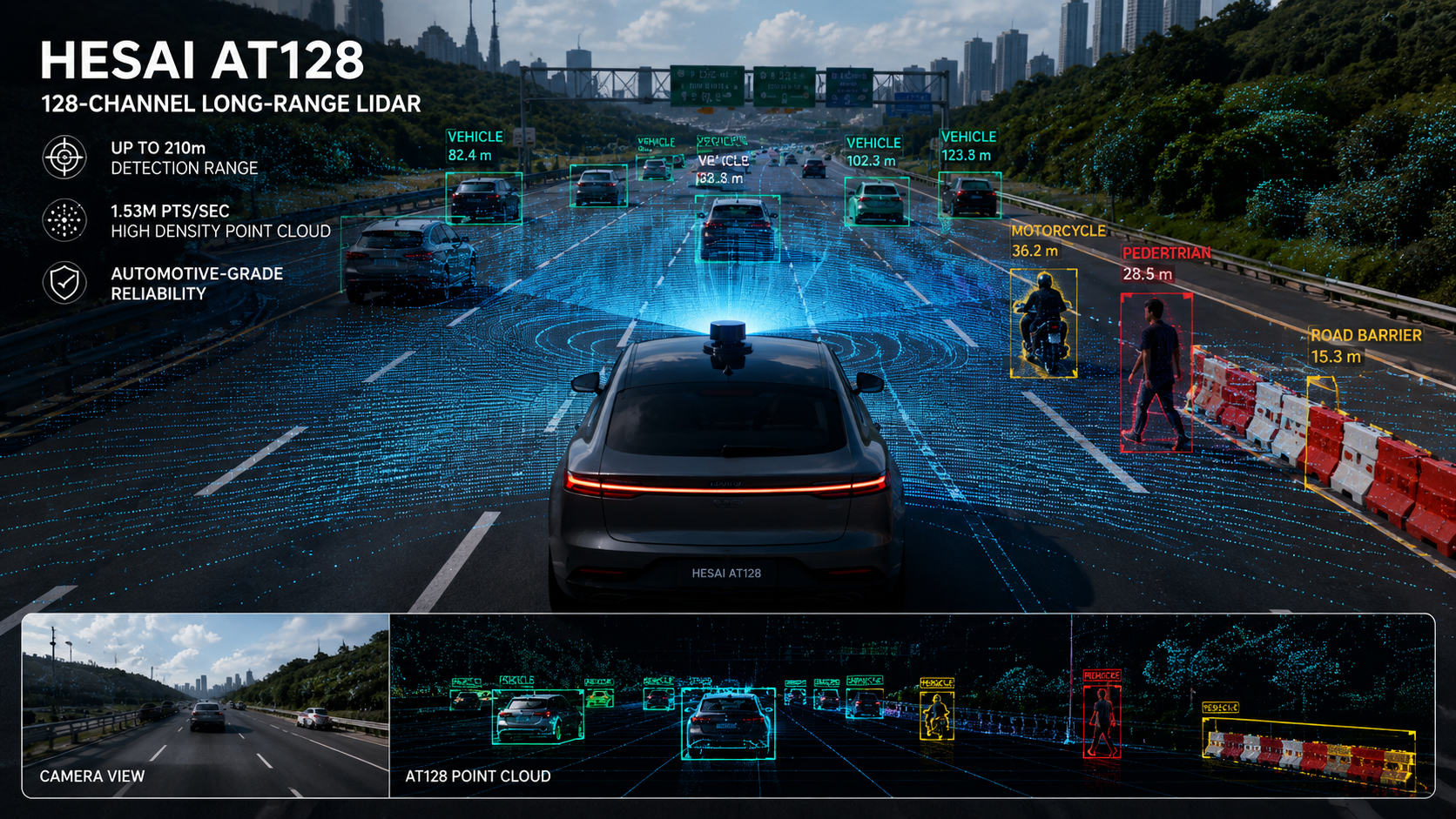
Introduction: Autonomous Driving Is Entering a New Era of Perception
Over the past decade, autonomous driving has evolved from an ambitious research concept into one of the most important technological transformations in modern transportation. Automotive manufacturers, robotaxi operators, artificial intelligence companies, and semiconductor developers are investing billions of dollars every year to create safer, smarter, and more autonomous vehicles.
Most discussions surrounding autonomous driving focus heavily on artificial intelligence, neural networks, and computing power. While these technologies are undeniably important, they all depend on one fundamental requirement: accurate perception of the surrounding environment.
An autonomous vehicle can only make intelligent decisions if it accurately understands the world around it. It must continuously detect vehicles, pedestrians, cyclists, road debris, construction zones, traffic signs, lane markings, and countless other objects in real time. Every acceleration, braking maneuver, lane change, and collision avoidance action begins with perception.
This growing demand for reliable environmental awareness has accelerated the adoption of advanced LiDAR technology. Among the newest generation of automotive-grade sensors, the Hesai AT128 has emerged as one of the most influential innovations in the industry. Combining ultra-long-range detection, high-resolution point cloud generation, and automotive-grade reliability, the AT128 is helping redefine how Advanced Driver Assistance Systems (ADAS) and autonomous driving platforms perceive the world.
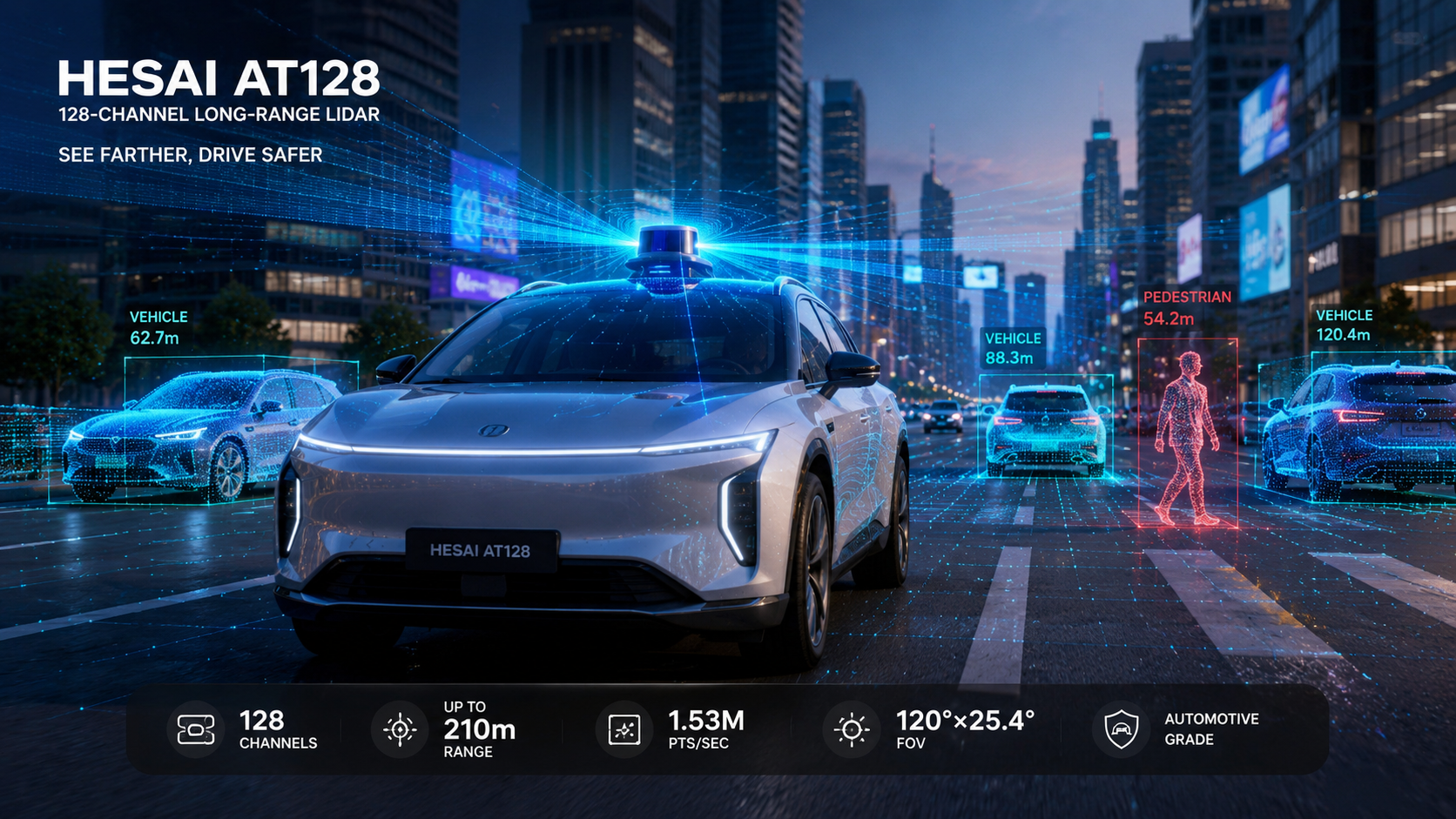
Why Perception Has Become the Biggest Challenge in Autonomous Driving
Many people assume autonomous driving is primarily an artificial intelligence problem. In reality, perception remains one of the industry’s most difficult challenges.
Human drivers possess an extraordinary ability to interpret complex environments. We can instantly recognize pedestrians, anticipate the behavior of other drivers, identify road hazards, and adapt to changing conditions. Replicating these abilities through sensors and software is significantly more difficult than it appears.
Modern vehicles typically rely on a combination of cameras, radar, ultrasonic sensors, and increasingly, LiDAR. Each technology contributes unique strengths, but each also has limitations.
Cameras provide rich visual information but can struggle in low-light conditions, direct sunlight, fog, heavy rain, and snow. Radar offers reliable velocity measurements and strong performance in adverse weather but lacks the spatial resolution necessary for precise object classification.
As autonomous driving systems become more sophisticated, these limitations become increasingly problematic. Vehicles must not only detect objects but also understand what those objects are, predict their behavior, and determine how to respond safely.
This growing need for perception accuracy is one of the primary reasons why automotive-grade LiDAR is becoming an essential component of next-generation ADAS platforms.
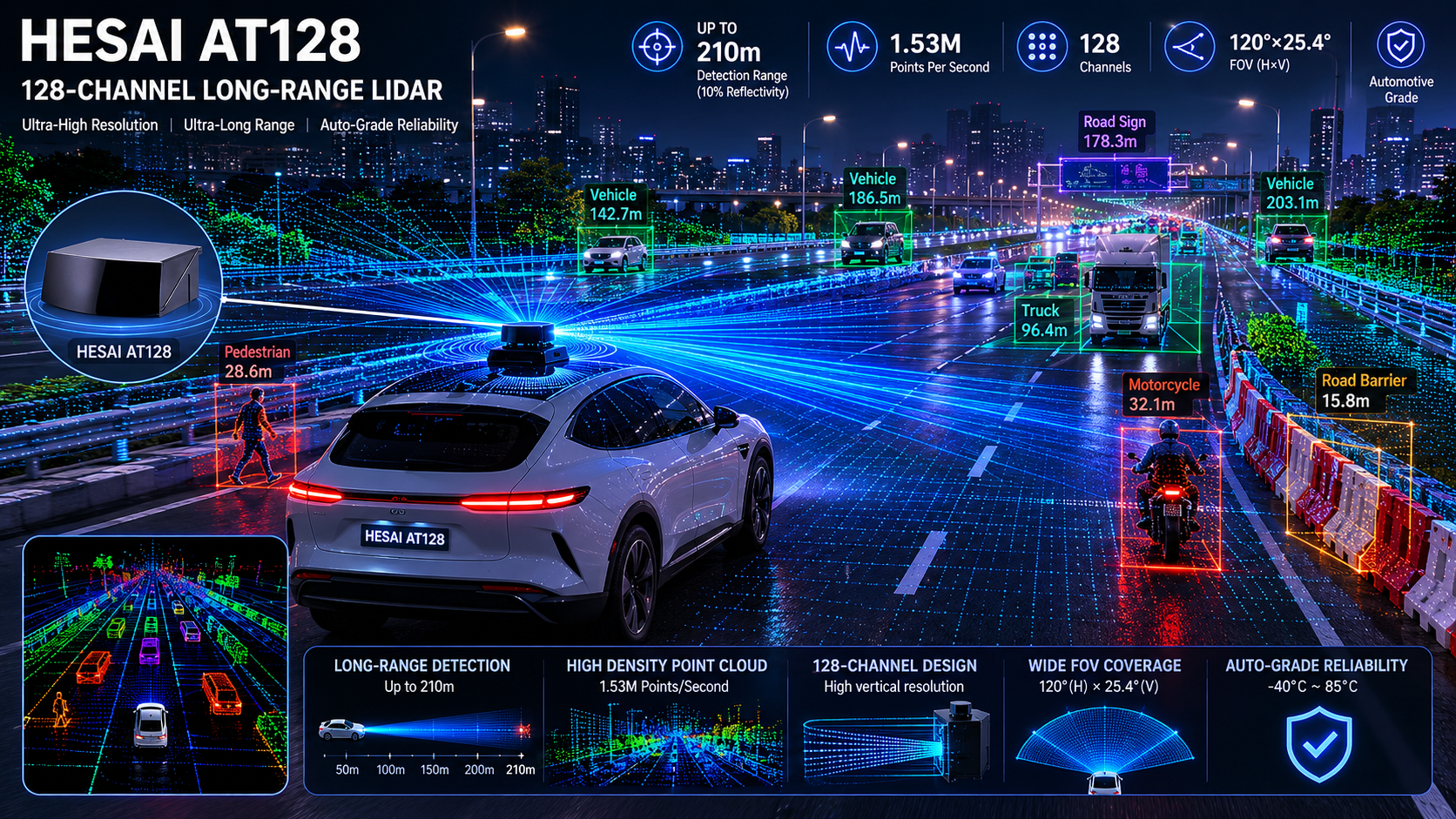
Why Long-Range Detection Is the Next Battlefield for ADAS Systems
One of the most significant trends in the automotive industry today is the growing focus on long-range perception.
As vehicles become more autonomous, the distance at which they can reliably detect and classify objects directly influences safety performance. A vehicle traveling at highway speed covers a considerable distance every second. Detecting a hazard even a few seconds earlier can provide critical additional time for path planning, braking, or evasive maneuvers.
Traditional sensor systems often struggle to identify low-reflectivity objects at long distances. Dark-colored vehicles, road debris, pedestrians wearing dark clothing, and construction equipment can all present perception challenges.
The industry is therefore shifting from a mindset of simple detection toward one of early detection. Engineers increasingly recognize that detection range is not merely a specification—it is a safety feature.
This trend has created strong demand for sensors capable of generating detailed environmental awareness hundreds of meters ahead of the vehicle. Long-range LiDAR sensors such as the Hesai AT128 are specifically designed to address this requirement by delivering exceptional perception performance at extended distances.
The ability to identify potential hazards earlier improves reaction time, increases confidence within autonomous driving algorithms, and contributes directly to safer vehicle operation.
Why 128 Channels Matter More Than Most Buyers Realize
When organizations search for a LiDAR sensor, they often focus primarily on maximum detection range. While range is certainly important, experienced perception engineers understand that channel count can be equally critical.
Channel count directly affects point cloud density.
A higher channel count enables the sensor to collect more environmental information, creating a more detailed representation of surrounding objects. This additional detail improves classification accuracy and helps autonomous systems distinguish between different types of obstacles.
The Hesai AT128’s true 128-channel architecture generates dense point clouds that reveal significantly more information about the environment than lower-resolution alternatives.
For example, the system can more accurately distinguish between a pedestrian, a cyclist, a traffic cone, and a roadside barrier. This capability becomes increasingly important in urban environments where hundreds of objects may appear simultaneously.
Dense point clouds also improve the performance of machine learning models by providing richer training and operational data. As AI systems continue to evolve, the value of high-resolution perception will only increase.
This is one reason why many industry experts believe high-channel-count LiDAR sensors will become standard components of future autonomous vehicles.
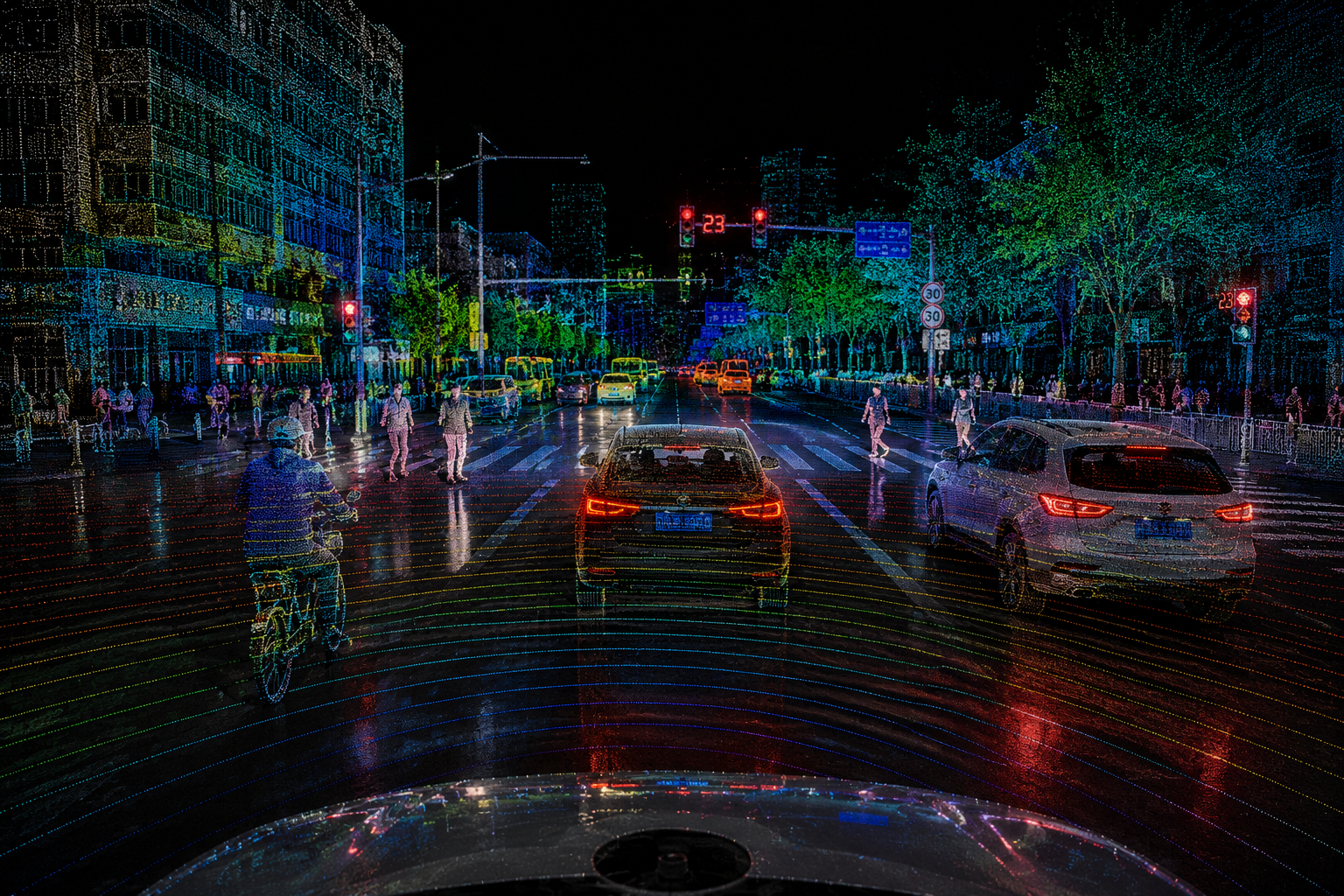
The Rise of Sensor Fusion and Why LiDAR Plays a Central Role
One of the biggest misconceptions about autonomous driving is that a single sensor technology will eventually solve all perception challenges.
The reality is that the future belongs to sensor fusion.
Sensor fusion combines information from cameras, radar, LiDAR, GPS, inertial measurement units, and other data sources to create a more comprehensive understanding of the environment.
Each sensor contributes unique strengths.
Cameras excel at recognizing colors, text, and visual context.
Radar performs well in poor weather conditions and accurately measures velocity.
LiDAR provides highly accurate three-dimensional spatial awareness.
By combining these technologies, autonomous systems achieve higher reliability and greater confidence in their decision-making processes.
Within this architecture, LiDAR serves as the foundation for precise environmental modeling. High-resolution sensors such as the Hesai AT128 provide the spatial accuracy necessary to anchor the entire perception stack.
As autonomous driving systems progress toward higher levels of automation, LiDAR’s role within sensor fusion architectures is expected to expand significantly.
Recommended Video:
Why Automotive Manufacturers Are Accelerating LiDAR Adoption
Only a few years ago, many industry observers questioned whether LiDAR would become mainstream within the automotive sector.
Today, the conversation has changed dramatically.
Increasingly stringent safety requirements, growing consumer expectations, advances in AI, and improvements in LiDAR manufacturing have all contributed to wider adoption.
Automotive manufacturers are recognizing that achieving reliable Level 3 and Level 4 autonomy requires perception redundancy. Cameras and radar alone may not provide sufficient environmental awareness across all operating conditions.
LiDAR fills this gap by delivering direct distance measurements and detailed 3D representations of the world.
The Hesai AT128 exemplifies this evolution by combining automotive-grade durability with long-range perception and high-resolution sensing capabilities.
As deployment volumes continue to increase, LiDAR is rapidly transitioning from an optional premium feature into a foundational component of intelligent mobility systems.
Explore More Automotive LiDAR Solutions
If you are evaluating automotive LiDAR sensors for ADAS, autonomous driving, robotics, or intelligent transportation projects, explore additional solutions available through LidarSeek.
Featured Product
Hesai AT128 Automotive LiDAR
Related Products
Hesai QT128
RoboSense Airy
Frequently Asked Questions
1. What is the Hesai AT128?
The Hesai AT128 is a 128-channel automotive-grade LiDAR sensor designed for ADAS and autonomous driving applications.
2. Why is long-range detection important?
Long-range perception gives autonomous systems more time to detect hazards and make safe driving decisions.
3. What makes 128-channel LiDAR different?
Higher channel counts create denser point clouds, improving object recognition and classification accuracy.
4. Is the AT128 suitable for autonomous driving?
Yes. The AT128 is specifically designed for advanced ADAS systems, robotaxis, and autonomous vehicle platforms.
5. Can LiDAR work at night?
Yes. LiDAR actively emits laser pulses and is not dependent on ambient light.
6. Does LiDAR work in rain and fog?
Modern automotive LiDAR systems are designed to operate under a wide range of weather conditions, although performance can vary depending on severity.
7. Why do autonomous vehicles need sensor fusion?
Sensor fusion combines the strengths of cameras, radar, and LiDAR to create more reliable environmental awareness.
8. What industries use automotive LiDAR?
Automotive, robotics, logistics, autonomous trucking, smart cities, and intelligent transportation infrastructure.
9. How does LiDAR compare with cameras?
LiDAR provides accurate depth information, while cameras provide rich visual context.
10. How does LiDAR compare with radar?
LiDAR offers significantly higher spatial resolution, while radar excels at velocity measurement and adverse-weather performance.
11. Can the AT128 be used for robotaxis?
Yes. Its long-range detection and high-resolution point cloud generation make it suitable for robotaxi deployments.
12. Where can I buy LiDAR sensors?
You can explore automotive and robotics LiDAR solutions at: https://lidarseek.com/shop









