
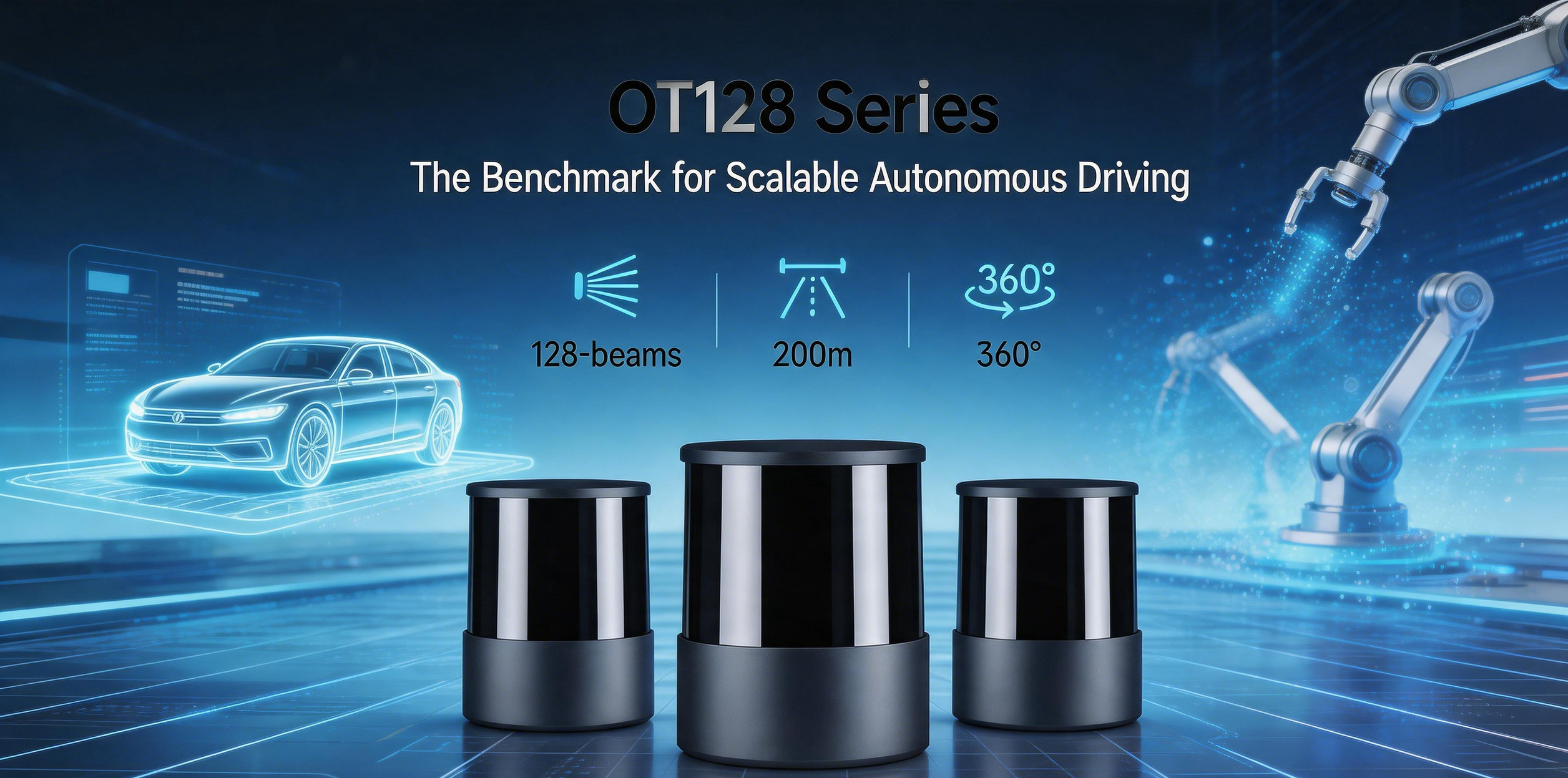
The Perception Gap in Modern Autonomous Systems

Autonomous vehicles operating at L4 don’t get second chances — and cameras and radar alone cannot close the gap between controlled demos and real-world reliability.
Cameras deliver rich color data but collapse under low-light conditions, glare, and visual clutter. Radar handles speed detection and basic obstacle identification, yet produces coarse spatial models that miss pedestrians stepping off curbs or debris scattered across a lane. Neither technology generates the dense, three-dimensional map of the physical world that L4 autonomy demands at highway speeds or in dense urban intersections.
“LiDAR is the only technology that provides the high-resolution 3D spatial data necessary for safe navigation in complex urban environments where cameras and radar fall short.” — SAE International
This is the perception gap — and it’s widest precisely where the stakes are highest. Consider what L4 autonomous systems must resolve in a single second of city driving:
- Occluded pedestrians partially hidden behind parked trucks
- Low-reflectivity objects like dark clothing or wet pavement markings
- Unpredictable cyclists merging from bike lanes without signaling
- Debris and potholes invisible to forward-facing camera arrays
LiDAR sensors solve this by casting millions of laser pulses per second and reconstructing precise 3D point clouds, regardless of lighting or visual ambiguity. The output is geometric truth — not an inference from pixel patterns.
However, the industry has long wrestled with a secondary problem: bridging the gap between experimental hardware that works in controlled pilots and production-ready sensors capable of surviving automotive-grade deployment cycles. Early lidar generations were fragile, expensive, and inconsistent at scale.
That engineering threshold is exactly where the Hesai OT128 enters the conversation — and what its 128-channel architecture is designed to address.
Hesai OT128: Engineering for the 200-Meter Horizon
The OT128 redefines what autonomous driving lidar can deliver by combining extreme point cloud density with detection range that matches real highway stopping distances.
Channel count is the backbone of spatial resolution. With 128 channels firing simultaneously, the OT128 generates a point cloud dense enough to resolve fine structural details — the difference between a pedestrian and a bollard, or a cyclist and a roadside sign. Lower-channel sensors commonly used in early L4 deployments produce sparser returns that force perception algorithms to interpolate, introducing classification uncertainty precisely where accuracy matters most.
The 200-meter detection benchmark deserves scrutiny because conditions rarely cooperate. According to Hesai Technology’s official product specifications, the OT128 achieves that 200-meter range against targets with just 10% reflectivity — essentially a dark, matte surface. In practice, this is the threshold that separates sensors suited for controlled test tracks from those ready for unstructured, real-world environments where black rubber tires, wet asphalt, and dark clothing are constant variables.
| Specification | OT128 Value |
|---|---|
| Channels | 128 |
| Max Detection Range | 200 m |
| Minimum Reflectivity (at 200 m) | 10% |
Angular resolution amplifies the value of channel density. A tighter vertical angular resolution means returns cluster closer together on any given object’s surface. This directly improves the confidence scores of classification models — a critical factor when a vehicle must distinguish a stationary obstacle from road debris at 60 mph with milliseconds to react. For teams evaluating sensor trade-offs across platforms, these three specifications compound: more channels, longer low-reflectivity range, and tighter angular resolution work together rather than independently.
Raw specifications, however, only tell part of the story. Whether these capabilities hold up under the thermal stress, vibration, and shock cycles of production vehicles depends on something beyond sensor physics — it depends on how the hardware is certified.
Why Automotive-Grade Certification is Non-Negotiable
Choosing the right lidar for autonomous vehicles isn’t just a technical decision — it’s a liability decision, and certification is where the two worlds collide.
“Industrial-grade” and “automotive-grade” are not interchangeable. Industrial-grade components tolerate controlled environments, defined duty cycles, and predictable failure modes. Automotive-grade components must survive extreme temperature swings, road vibration, electromagnetic interference, and decade-long service intervals — all while operating safely around human beings. The gap between the two standards is enormous, and for L4 applications, only automotive-grade qualifies.
ASIL B Explained: The OT128 meets ISO 26262 ASIL B — the functional safety standard that governs electronic systems in road vehicles. ASIL (Automotive Safety Integrity Level) runs from A to D, with D representing the most stringent requirements. ASIL B targets systems where a failure could cause serious injury, demanding rigorous hazard analysis, fault detection mechanisms, and documented diagnostic coverage. For a 128-channel rotating lidar handling real-time 3D perception at highway speeds, that level of certification isn’t a checkbox — it’s the foundation of a trustworthy system.
For procurement teams and safety engineers evaluating sensor platforms, certification delivers three concrete benefits:
- Reduced liability exposure. Deploying a certified sensor shifts the burden of proof — OEMs can demonstrate due diligence in regulatory and legal proceedings.
- Faster regulatory approval. Safety homologation processes move quicker when sensor documentation already aligns with recognized standards, cutting months from development timelines.
- Validated integration pathways. ASIL B certification signals compatibility with broader functional safety architectures, simplifying how teams build autonomous sensor stacks around a compliant core component.
In practice, certification is what separates a demo-ready sensor from a production-ready one — and it’s one reason the OT128’s engineering story extends well beyond hardware specs alone.
The Evolution of Hesai Technology in Global 3D Perception

Hesai has emerged as a definitive force in automotive lidar sensors, built on a foundation of rapid hardware innovation and deep integration with global OEM programs.
Hesai’s ascent wasn’t accidental — it was engineered through a deliberate shift from bulky mechanical spinning designs toward compact, high-performance hybrid and solid-state architectures. Early mechanical lidar offered proof-of-concept reliability, but the industry demanded sensors that could survive automotive supply chains, meet cost targets, and scale into millions of production units. Hesai answered that challenge directly, compressing years of iteration into a technology roadmap that now positions it alongside the most demanding programs in autonomous mobility.
That progression matters for procurement managers evaluating long-term vendor stability. A supplier that has navigated the full arc — from research-grade spinning hardware to ASIL-B-certified solid-state and hybrid designs — brings a fundamentally different risk profile than newer entrants still maturing their manufacturing processes.
Market adoption tells the real story. Top-tier automotive OEMs across North America, Europe, and Asia have integrated Hesai sensors into L4 robotaxi fleets, highway pilot programs, and smart logistics platforms. The global automotive lidar market is projected to reach $4.7 billion by 2029, driven by the accelerating transition to Level 4 automation — and Hesai is positioned to capture a significant share of that growth, backed by proven volume production and established OEM relationships.
For engineers benchmarking next-generation perception stacks, understanding a manufacturer’s full technology evolution — not just its current flagship — is essential context.
That market-level confidence, however, only holds up under real operating conditions. The next section examines exactly how the OT128 performs where autonomous systems fail most often: complex urban environments and low-light edge cases.
Solving the Edge Case: Urban Navigation and Low Light
The most demanding test for any vehicle lidar sensor isn’t the open highway — it’s a rain-slicked urban intersection at night, with dark clothing, wet asphalt, and unpredictable pedestrians in every direction.
Low-reflectivity surfaces are where most perception systems fail. Objects like black rubber bumpers, dark-painted vehicles, and worn road markings absorb rather than reflect laser pulses, creating gaps in point cloud data precisely where gap tolerance is zero. In fog or rain, forward scatter compounds the problem, generating noise that simpler systems misinterpret as obstacles — triggering false braking events or, worse, masking real ones.
The OT128 addresses this through a combination of high-sensitivity receiver design and refined return-signal processing. By capturing multiple return signals per pulse, it reconstructs surfaces that other sensors simply miss. The result is reliable detection of low-reflectivity targets even in adverse weather — a capability that directly reduces false positives by giving the perception stack cleaner, denser input data.
360-degree coverage is the other half of the equation. Urban intersections demand full situational awareness simultaneously — cyclists approaching from the left, a truck turning from the right, a pedestrian stepping off the curb behind the vehicle. The OT128’s full 360° horizontal field of view eliminates the blind-spot stitching errors that plague multi-sensor array configurations. A single, coherent point cloud makes real-time decision-making faster and more reliable.
Hesai’s selection by a top global automotive OEM for production ADAS programs validates these urban performance claims in the real-world conditions that matter most — not controlled test tracks, but live traffic. For teams evaluating perception hardware across deployment environments, high-density beam performance benchmarks offer useful context for comparing resolution thresholds.
When performance requirements are this precise, procurement decisions carry equal weight — a reality the next section addresses directly.
Procurement Strategy: Balancing High Specs with Cost Sensitivity
Choosing the right LiDAR sensor is only half the battle — how you acquire, support, and replace it can determine whether a deployment succeeds or stalls.
Hidden downtime costs are frequently underestimated in LiDAR procurement decisions. When a sensor fails mid-deployment, the cascade effect is immediate: production stops, data pipelines break, and fleet schedules collapse. For L4 autonomous programs operating on tight development timelines, even a 48-hour sensor gap can set back validation cycles by weeks. The true cost of downtime almost always exceeds the cost of the hardware itself.
Direct-from-manufacturer pricing is now reshaping how teams budget for high-channel sensors like the Hesai OT128. Traditional distribution chains added significant margin at every step, making flagship sensors feel financially out of reach for mid-size robotics and research teams. Specialized global suppliers — operating with direct manufacturer relationships — have disrupted that model. By cutting intermediary markups, they bring automotive-grade perception hardware into realistic budget ranges without sacrificing certification or authenticity. For teams comparing high-channel sensor options across different use cases, that pricing transparency is genuinely valuable.
Certified hardware guarantees close the final gap in procurement confidence. Lidarseek operates as a specialized global LiDAR supplier offering direct-from-manufacturer pricing alongside a 24-hour replacement guarantee — meaning a failed unit is on its way back to you within one business day, not three weeks.
Key callout: A 24-hour support guarantee isn’t just a logistics promise — it’s a risk management tool that protects ROI on every deployment.
In practice, procurement teams that prioritize certified supply chains and fast-response support structures report fewer unplanned integration delays. That operational reliability becomes the natural bridge into how these sensors perform across surveying, smart factories, and R&D ground-truth applications.
Integration and R&D: From Surveying to Smart Factories
The OT128’s automotive-grade engineering makes it one of the most versatile 3D LiDAR sensor platforms available — equally at home in a survey drone payload, a factory floor AGV, or a university robotics lab.
High-resolution automotive sensors aren’t just for roads — they’re redefining precision across entire industries.
Surveying and Mapping Traditional survey-grade scanners carry steep price premiums and narrow deployment windows. The OT128’s 360° field of view, cited as critical for commercial deployment across autonomous trucking and industrial robotics, translates directly into dense, georeferenced point clouds for infrastructure inspection and terrain modeling. Fewer scan passes mean faster project turnaround and lower operational cost.
Smart Factory AGVs Warehouse throughput lives or dies by how quickly automated guided vehicles can navigate dynamic environments safely. The OT128’s 200 m range — far exceeding what a typical factory corridor demands — gives AGV planners a meaningful buffer: the sensor detects personnel, forklifts, and pallet stacks early enough to reroute without stopping. In practice, that reaction distance converts directly into higher picks-per-hour and reduced downtime across high-density fulfillment operations.
R&D and Ground-Truth Validation Engineering teams developing camera fusion algorithms or radar pipelines routinely need a reference sensor they can trust unconditionally. The OT128 fills that role cleanly — its 128-channel density and stable return accuracy make it a reliable benchmark for perception testing, whether teams are validating SLAM outputs or stress-testing edge-case object classification. The result is shorter iteration cycles and more defensible safety data.
With the OT128’s cross-domain versatility now clear, the key decision criteria — from channel count to certification to total procurement cost — are worth consolidating into a final, actionable summary.
Key Takeaways for LiDAR Selection
Selecting the right automotive-grade LiDAR platform means balancing raw technical performance, safety certification, supply chain reliability, and total cost of ownership — and the OT128 addresses all four.
The OT128 raises the bar for L4 perception hardware. Here’s what engineers and procurement teams should carry forward from everything covered above:
- 128-channel resolution with 200m range. The OT128’s point cloud density and detection distance aren’t incremental upgrades — they’re designed to meet the safety margins L4 autonomy actually requires, giving systems enough time and spatial data to make reliable decisions at speed.
- ISO 26262 ASIL B certification is non-negotiable for scaling. Whether you’re deploying robotaxi fleets or integrating sensors into industrial automation lines, certified hardware dramatically simplifies regulatory approval and reduces liability exposure across the product lifecycle.
- Hesai’s market position translates to long-term reliability. As a global leader in LiDAR shipments, Hesai’s production scale supports consistent hardware availability, active firmware development, and multi-year support commitments — factors that matter deeply once a platform moves from prototype to production.
- Specialized distribution cuts friction. Sourcing through distributors with deep LiDAR expertise, like Lidarseek, reduces lead times, lowers per-unit costs, and provides technical support that generic electronics distributors simply can’t match. For teams exploring how perception hardware fits into broader robotics systems, that application-level guidance can be the difference between a fast deployment and a costly integration mistake.
In practice, no single specification wins a deployment — it’s the combination of certified performance, vendor stability, and smart procurement that determines whether a LiDAR investment delivers at scale. The OT128 checks each of those boxes, which points naturally to a broader question: what comes next for teams ready to act on that potential?
The Future of Autonomous Perception with Lidarseek
Choosing the right LiDAR sensor is no longer just a hardware decision — it’s a strategic commitment that shapes the entire trajectory of an autonomous system.
The broader industry shift is unmistakable: high-specification, automotive-grade sensors like the OT128 are now available at price points that make large-scale deployment genuinely feasible. What once required compromise — trading range for resolution, or channel count for cost — is increasingly a solved problem. The convergence of ISO 26262 ASIL-B certification, 128-channel density, and sub-$1,000-per-unit pricing at scale marks a turning point for L4 perception engineering.
However, no single sensor is the right answer for every application. A high-channel rotating lidar excels at 360° environmental mapping but may be overspecified for a fixed-infrastructure inspection role. Solid-state alternatives offer form-factor advantages in constrained mounting scenarios. Acknowledging these trade-offs honestly is the first step toward a well-matched sensor stack.
That’s where technical consulting adds measurable value. Working with specialists who understand both the hardware specifications and the real-world deployment constraints helps engineering and procurement teams avoid costly mismatches. Key considerations before committing to a sensor platform include:
- Detection range requirements relative to operating speed and stopping distance
- Environmental certification needs (IP ratings, operating temperature, vibration tolerance)
- Integration complexity — ROS compatibility, SDK maturity, and point cloud output format
- Total cost of ownership, including calibration, maintenance, and replacement lead times
- Regulatory and safety certification requirements for the target market
For engineers and procurement teams ready to move forward, the next step is straightforward. Evaluate the OT128 against your specific use case parameters, request sample data sets from real deployment environments, and consult with a LiDAR specialist who can benchmark it against your existing solutions. Lidarseek’s sensor comparison resources are a practical starting point for building a shortlist grounded in technical reality rather than spec-sheet optimism.









